
Credit card processing costs have climbed from a “back-office expense” to a line item many businesses feel every day. That’s why surcharging—adding a fee when a customer chooses a credit card—has become common in retail, professional services, healthcare, auto repair, and B2B invoicing.
But surcharge rules are not “set it and forget it.” They sit at the intersection of card network requirements, state-level restrictions, pricing transparency laws, and your processor’s operating rules.
This guide explains surcharge rules and compliance in plain language: what surcharging is, when it’s allowed, how to disclose it correctly, how to calculate a compliant rate, and how to avoid penalties.
You’ll also learn practical implementation steps for in-store and online checkout, and how to document your approach so your business can prove surcharge compliance during an audit or dispute. Where available, this article also includes forward-looking trends that may shape surcharge rules in the next few years.
Foundations of surcharge rules and compliance
Getting surcharge rules right starts with clarity. Many businesses mix up surcharges, cash discounts, and convenience fees. That confusion is one of the fastest ways to trigger customer complaints—or worse, a card network violation.
A surcharge is specifically tied to credit card acceptance and is governed by detailed brand standards, processor policies, and, in some areas, state-level pricing rules. The biggest compliance mistake is applying a credit card surcharge to debit or prepaid products, or failing to disclose it before the customer pays.
The second most common error is charging a flat percentage without checking the required cap (often tied to your actual cost of acceptance).
Surcharge compliance also requires consistent execution across locations and channels: your signage, receipts, online checkout language, and transaction data must align. If your point-of-sale system displays one amount but the receipt shows another, your surcharge rules program is already at risk.
Finally, remember that compliance is not only about avoiding penalties—it’s also about trust. Customers don’t mind paying a fee when they understand it upfront and it feels predictable. Strong disclosure and consistent pricing presentation turn surcharge rules from a legal headache into a manageable business policy.
What counts as a surcharge (and what does not)
A surcharge is an additional charge added at checkout because the customer uses a credit card. Under common card network surcharge rules, it must be clearly labeled and disclosed before payment, and it must apply only to eligible credit card transactions—not debit or prepaid cards.
Visa’s guidance describes a surcharge as an added fee for using a particular form of payment and outlines specific compliance steps for merchants that choose to surcharge.
What does not count as a surcharge? A few common examples:
- Cash discount: You post a “regular price” and offer a discount for cash (or another method). This is often treated differently under state law than a credit surcharge and is commonly permitted even where surcharging is restricted. Some states explicitly allow cash discounts while prohibiting surcharges.
- Convenience fee: A fee for using an alternative payment channel (for example, paying online instead of in-person), not for using a credit card itself. Convenience fees have their own brand rules and must be structured carefully (for example, channel-based, properly disclosed, and often tied to specific merchant categories or use cases).
- Service fee: Sometimes used in B2B invoicing or professional services, but if it’s applied only when a customer uses a credit card, it can be treated like a surcharge under surcharge rules.
What you can and can’t surcharge
Most card network surcharge rules focus on credit products. Visa’s guidance is explicit that surcharging must be limited to credit cards and that debit and prepaid cards cannot be surcharged.
Mastercard’s merchant guidance similarly frames surcharging as a credit-card-only practice and ties the permitted amount to the merchant’s cost of acceptance, subject to a published cap.
Where merchants get into trouble is at the register when the terminal routes a transaction in an unexpected way. For example:
- A customer presents a debit card, but the transaction is processed on a “credit” rail at the terminal. Many systems still identify the product as debit/prepaid in the card data, and the surcharge rules still treat it as debit/prepaid—meaning it should not be surcharged.
- A customer uses a prepaid card that looks like a typical credit card. Under most brand surcharge rules, prepaid is not eligible for surcharging even if it “feels” like credit at the counter.
- A merchant surcharges one brand but not another without meeting brand-level requirements and parity expectations.
The safe approach for surcharge compliance is to configure your POS or gateway to automatically apply a surcharge only when the card product is identified as a compliant credit product, and to test across real card types.
Why surcharge compliance matters beyond fines
Surcharge rules are enforced through multiple channels. Card networks can require remediation, impose fines through your acquirer, or restrict your ability to surcharge. Processors may treat violations as a risk flag that increases reserves or leads to account reviews. And customer complaints can also escalate to state consumer protection regulators.
There’s another consequence that’s just as costly: chargebacks and reputational damage. If a customer feels “surprised” by a fee—especially if disclosure is weak—you may see disputes, bad reviews, and lost repeat business.
Even if you technically followed part of the surcharge rules, inconsistent signage or confusing receipt labeling can cause a dispute to look “reasonable” from a customer perspective.
Strong surcharge compliance improves customer clarity. It also helps your staff: clear scripts reduce awkward conversations at checkout. In practice, the best surcharge programs treat disclosure as a customer experience feature, not a legal footnote.
The key players that set surcharge rules
Understanding who makes surcharge rules helps you know where to look for updates:
- Card networks publish operating rules and guidance (Visa, Mastercard, and others). Visa’s merchant surcharging guidance outlines steps such as advance notice to your acquirer, disclosure requirements, limits, and transaction data expectations.
- Your acquirer/processor enforces network rules contractually and typically requires notification and configuration support for compliant surcharging. Mastercard’s materials emphasize notice requirements and direct merchants to official notification channels.
- State laws and consumer protection agencies can restrict or shape how surcharges must be displayed or whether they’re allowed. Connecticut’s consumer protection guidance, for example, states that its law prohibits surcharges while allowing cash discounts.
- Federal regulators influence pricing transparency. The FTC’s Rule on Unfair or Deceptive Fees (focused on live-event tickets and short-term lodging) requires total price disclosure and targets bait-and-switch fee presentation. Even if your business is outside those industries, the rule reinforces the broader compliance trend toward upfront, all-in pricing.
For reliable surcharge compliance, treat your surcharge policy as a living program and revisit it whenever your processor, card networks, or state regulators update expectations.
Legal landscape and disclosure laws that shape surcharging
Even when card network surcharge rules allow surcharging, state rules may restrict it or dictate how prices must be displayed. The legal landscape is not static; states have amended laws after court challenges, and consumer-protection agencies have issued clearer guidance.
One of the biggest compliance traps is assuming that “it’s legal in most places” means “it’s legal everywhere my customers are.” If you sell across state lines online, or if you have multiple locations, surcharge compliance must account for each outlet location and where transactions occur.
Another major compliance theme is transparency. Consumer protection laws often focus less on banning fees and more on preventing surprise fees at checkout. That means your signage, menus, proposals, invoices, estimates, and online checkout pages may need to show either the total credit price or both prices (cash vs credit) in a way that is “clear and conspicuous.”
New York’s amended approach, for example, centers on requiring merchants to clearly disclose the total credit price inclusive of the surcharge or to display both the credit price and cash price.
Finally, federal action is shaping norms for “junk fees” and mandatory charges—especially in ticketing and lodging—by requiring upfront total price disclosure. This doesn’t rewrite card network surcharge rules, but it does raise the bar for disclosure expectations across industries.
State restrictions and outright bans you must check
State-by-state legality is one of the most important factors in surcharge rules and compliance. Some states allow surcharges within network caps, some restrict them through disclosure requirements, and some prohibit them entirely (while still permitting cash discounts).
Connecticut is a clear example: state guidance explains that the law prohibits a surcharge—defined as an extra charge for using one payment type over another—while allowing cash discounts.
If you operate there, your surcharge program may need a different strategy (like dual pricing or cash discounting) to remain compliant.
Because state rules change, surcharge compliance requires periodic verification through your legal counsel or state consumer protection resources—especially if you’re expanding locations, launching online sales, or changing how your fees appear at checkout.
Price display rules and the “no surprise surcharge” standard
Many legal disputes about surcharging are really disputes about speech and disclosure. New York is a practical case study. The state amended its approach to focus on preventing surprise surcharges at checkout and requiring clear price presentation.
Guidance around the updated standard emphasizes that sellers must clearly and conspicuously post the total credit price inclusive of any surcharge, or display both the credit price and cash price.
This matters for your surcharge rules program because you can’t treat disclosure as a tiny sign near the register. If a customer reaches the point of payment and only then learns about the surcharge, you’re exposed—legally and reputationally—even if your card network steps were otherwise correct.
For surcharge compliance, think like a customer: the surcharge should be obvious at the earliest reasonable moment (store entry, menu board, service agreement, online checkout page), repeated at the point of transaction, and confirmed on the receipt.
Federal transparency momentum and why it affects surcharging
The FTC’s Rule on Unfair or Deceptive Fees targets bait-and-switch fee practices and requires total price disclosure for live-event tickets and short-term lodging, with an effective date of May 12, 2025.
While this rule doesn’t directly set credit card surcharge rules for general retail, it signals where fee enforcement is headed: regulators are prioritizing clear, upfront disclosure of mandatory charges.
This matters because a surcharge is a mandatory charge once the customer chooses credit. If your business is in a sector touched by this rule (ticketing, lodging), you should assume a higher standard of scrutiny for how surcharges and other fees are advertised and displayed.
Even outside those sectors, the “all-in pricing” expectation is becoming a market norm, and customers increasingly expect to see the full price early.
So, surcharge compliance is not just about satisfying card networks; it’s about meeting the broader transparency standard that regulators and consumers are reinforcing.
Multi-location and online sales: where “location” matters
For surcharge rules, “where the merchant outlet is located” can matter because some network guidance and legal requirements are tied to the merchant’s location and the applicable laws of that jurisdiction.
Visa’s merchant guidance explicitly notes that surcharging is permitted in most states and territories and is subject to limitations such as the merchant outlet location and the card product presented.
If you have multiple storefronts, your program may need location-based rules (for example, surcharging in one state but not another). If you sell online nationwide, you should design checkout flows that satisfy your strictest required disclosure approach—so you don’t have to maintain dozens of variations.
Card network surcharge rules you must follow
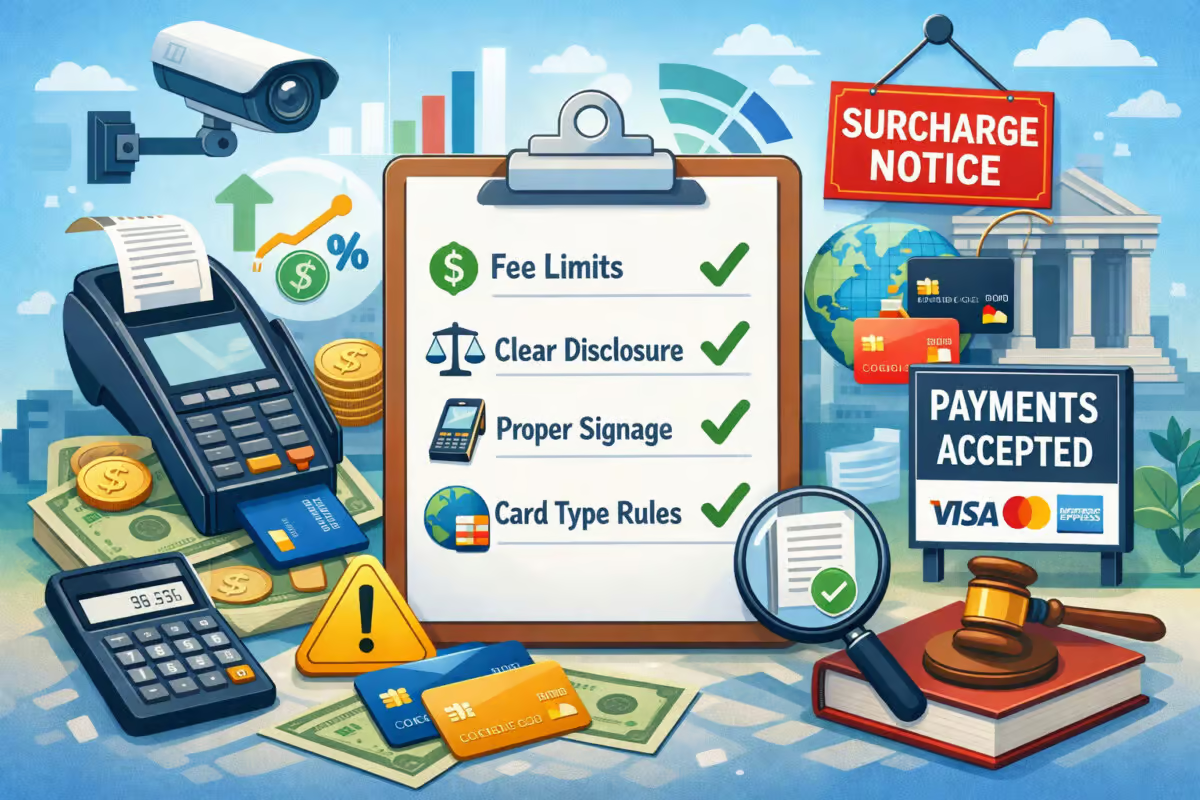
Card network surcharge rules are where most merchants get tripped up, because each network has its own caps, notices, and disclosure expectations. While the details vary, the major themes are consistent:
- Credit-only surcharging (no debit/prepaid)
- A cap tied to your cost of acceptance and/or a network maximum
- Advance notice requirements (often at least 30 days)
- Clear disclosure at the point of entry, the point of sale/transaction, and on the receipt
- Accurate transaction data so the network can identify surcharge amounts
In practice, your processor or surcharge program provider should help you configure these requirements correctly. But surcharge compliance is still your responsibility. You should be able to explain your cap calculation, show your disclosure screenshots/photos, and document your notice process.
Below are network-level highlights to anchor your surcharge rules program. Because network rules can be updated, always validate the current version with your acquirer and the network’s published guidance.
Visa surcharge rules: caps, disclosures, and transaction data
Visa’s merchant guidance for surcharging is very specific. It says that if you intend to surcharge, you must notify your acquirer at least 30 days prior, limit surcharging to credit cards only, and cap the surcharge at the lesser of your merchant discount rate (MDR) for the applicable credit card or 3%—whichever is lower.
It also requires clear consumer disclosure at the point of entry and point of sale/transaction, and on every receipt.
Visa also references a transaction messaging requirement: the surcharge amount should be included in a dedicated data field (often referenced in Visa materials as a specific field in the transaction message).
That requirement matters for surcharge compliance because it affects how your POS/gateway must be configured. If your system simply “adds a line item” without populating the expected data, your transactions may fail compliance checks.
From a practical standpoint, the Visa portion of surcharge rules and compliance comes down to four things:
- Get your notice and documentation done before you start
- Never apply the surcharge to debit or prepaid
- Cap it properly (MDR vs 3%)
- Disclose early and often
If you do those consistently, you remove the most common Visa-related compliance risks.
Mastercard surcharge rules: cost-based limits and notice expectations
Mastercard’s merchant guidance frames surcharge limits as cost-based. It explains that the fee a merchant may charge is capped relative to the merchant’s cost of Mastercard credit acceptance.
For brand-level surcharging, Mastercard states the surcharge must be the lesser of the merchant’s average effective merchant discount rate for Mastercard credit acceptance or the published maximum surcharge cap (commonly presented as 4% in the Mastercard materials).
Mastercard also emphasizes notice and disclosures. The Mastercard surcharge FAQ notes that merchants must provide Mastercard and their acquirer with at least 30 days advance written notice and must disclose surcharging practices at the point of sale and on the receipt.
For surcharge compliance, Mastercard’s framework reinforces a key best practice: don’t pick a “marketing number” like 3.5% and assume it’s safe. Your surcharge must be tied to your actual cost (average effective MDR) and must not exceed network caps.
That means you need a method to calculate and retain evidence of your cost basis, and you need to revisit it if your processing pricing changes.
American Express: why parity and fairness still matter
American Express publishes merchant regulations and updates them on a regular schedule (it notes that merchant regulations are published twice a year). The practical takeaway for surcharge rules is that Amex acceptance is governed by its own merchant terms, and your surcharging approach must not conflict with your Amex agreement.
In many surcharge programs, the biggest Amex risk is inconsistency—for example, surcharging Visa/Mastercard but attempting to treat Amex differently without understanding what your Amex terms allow, or presenting surcharge disclosures in a way that suggests unfair steering or discriminatory treatment.
Because Amex terms can be updated, surcharge compliance requires that you periodically review your Amex merchant documentation (or confirm with your processor) to ensure your checkout disclosures and fee logic align with your agreement.
Discover and other networks: apply consistent, cost-based logic
Discover’s public consumer education notes that some merchants offset processing fees by adding a surcharge and that some states don’t allow surcharging.
In training materials used in industry education, Discover surcharging is often described as permitted when the surcharge does not exceed the merchant fee paid for the card sale and when surcharging is also assessed on other card brands accepted by the merchant.
For surcharge rules and compliance, the safest approach is to treat Discover within a consistent, cost-based framework: surcharge only eligible credit products, apply a cap tied to your cost of acceptance, disclose clearly, and avoid brand-by-brand surprises unless your program is explicitly designed and approved for that.
When in doubt, your acquirer’s guidance should be your operational source of truth, because they enforce network requirements and can confirm what your specific merchant account supports.
Building a compliant surcharge program end-to-end
A compliant program is more than selecting a percentage. True surcharge compliance is a workflow: decide your policy, calculate your cap, notify the right parties, configure your systems, deploy disclosures, train staff, and monitor outcomes. Done right, surcharge rules become a repeatable operational standard rather than a recurring emergency.
Two principles matter most:
- Automation beats memory: The more your POS/gateway automatically identifies eligible credit products and applies the correct fee, the less you rely on employees to “do it right” every time.
- Documentation beats assumptions: If your surcharge is challenged, you should be able to show the basis for your rate and prove your disclosures were clear and timely.
This section turns surcharge rules into an actionable blueprint. You can use it whether you’re launching surcharging for the first time or auditing an existing setup that may have drifted out of compliance.
Setting the surcharge rate: the cap is not optional
Under common network surcharge rules, the permitted surcharge is not “whatever customers tolerate.” Visa’s cap is the lesser of your MDR for the applicable credit card or 3%—whichever is lower. Mastercard’s guidance caps the surcharge at the lesser of your average effective MDR for Mastercard credit acceptance or the published maximum surcharge cap.
So how do you set a compliant rate?
- Gather recent merchant statements (several months is better than one)
- Identify your effective processing cost for credit (separating out non-transaction fees when appropriate)
- Calculate an effective MDR basis that matches the network’s rule structure
- Choose a surcharge rate that does not exceed your calculated cost and does not exceed brand caps
- Store the calculation and supporting statements in a compliance folder
If your pricing changes (new interchange program, new processor, new risk category, new pricing tier), your surcharge cap may change too. That’s why surcharge compliance should include a quarterly or semiannual review—especially for seasonal businesses where transaction mix changes.
Notices and registrations: handle the “30-day” step correctly
Many merchants forget the notice step until the day they want to go live. But notice is a core piece of surcharge rules. Visa requires notifying your acquirer at least 30 days prior to commencing surcharging.
Mastercard’s surcharge FAQ similarly states that a merchant must provide Mastercard and their acquirer with a minimum of 30 days advance written notice before implementing a surcharge.
Operationally, build a simple “notice package”:
- Your business legal name and DBA
- Merchant ID(s) and locations
- Intended surcharge rate and policy statement
- Go-live date (at least 30 days out)
- Contact info for compliance questions
Then confirm with your acquirer how they want notice delivered and how they record it. Keep proof of submission (email confirmation, portal confirmation, or ticket ID). In surcharge compliance, proof matters.
Disclosure: point of entry, point of sale, and receipts
Disclosure is where most surcharge rules violations happen, and it’s also where customer trust is won or lost.
Visa states merchants must disclose the surcharge as a merchant fee and clearly alert consumers at the point of entry, the point of sale/transaction, and on every receipt (for in-store and online transactions). Mastercard’s FAQ also emphasizes disclosure at the point of sale and on the receipt.
A compliant disclosure system typically includes:
- Point of entry: a sign at the door or entrance, or an obvious notice before checkout online
- Point of sale/transaction: a prompt on the terminal screen, a line on the invoice, or a clear checkout message
- Receipt: a labeled line item that matches the disclosed policy
Your language should be plain and consistent: “A credit card surcharge of X% applies to credit card purchases. Debit cards are not surcharged.” Avoid vague phrases like “non-cash adjustment” unless your counsel confirms it’s compliant for your state and your customer base understands it.
Remember: great surcharge compliance treats disclosure as a system, not a single sign.
POS, gateway, and data requirements: make your tech do the work
Card networks increasingly expect surcharge amounts to be properly represented in transaction data, not just as an internal note. Visa’s merchant guidance references including the surcharge amount in a dedicated data field in the transaction message. Whether your POS supports this depends on your software, gateway, and processor.
A strong surcharge rules implementation checklist for technology includes:
- Confirm your POS/gateway can identify eligible credit products and exclude debit/prepaid
- Confirm the surcharge is calculated correctly per transaction and rounded consistently
- Ensure receipts show the surcharge clearly
- Validate that settlement data and reporting properly represent the surcharge
- Run live tests using real card types (credit, debit, prepaid, rewards cards)
- Document screenshots of checkout messaging for your compliance records
If you use a third-party surcharge program provider, ask them for a “compliance packet” showing how their system enforces caps and debit/prepaid exclusions. In surcharge compliance, vendor claims should be verifiable.
Risk management, audits, and the future of surcharge rules
Even a well-built program can drift. Employees rotate. POS settings change. New locations open. E-commerce themes get redesigned. That’s why mature surcharge compliance includes monitoring, internal audits, and customer feedback loops. The goal is to spot issues before a network, regulator, or customer escalates them.
Risk management also includes being realistic about customer experience. If your surcharge rules are technically compliant but customers feel misled, you’ll still pay through disputes and churn. Good programs pair compliance with empathy: clear signage, consistent language, and options (like ACH, cash discounting, or debit routing).
This section also looks forward. Transparency expectations are rising. Federal enforcement has already targeted hidden mandatory fees in certain industries. States are refining rules, and some continue to restrict surcharges. The future of surcharge rules will likely demand better disclosure, cleaner receipts, and more standardized price presentation.
Monitoring and penalties: what happens when surcharge compliance fails
The most common enforcement path is through your acquirer. Networks typically enforce surcharge rules by requiring your acquirer to correct merchant behavior and, in some cases, assess penalties.
Even if you never see a “fine letter,” you may see indirect consequences: increased scrutiny, reserves, delayed funding, or termination risk if the merchant is seen as non-compliant.
You can reduce exposure with a simple monitoring routine:
- Monthly review of receipts (in-store and online)
- Quarterly test transactions using different card product types
- Periodic signage checks at every location
- Review of your surcharge rate against updated effective MDR calculations
- Confirmation that debit/prepaid are not being surcharged
If you discover a mistake, treat remediation as part of surcharge compliance: fix it, document what changed, and keep records showing when the issue started and when it was corrected.
Handling customer complaints and disputes the right way
Customers often complain about surcharges for one reason: surprise. When that happens, the worst move is to argue. The best move is to explain clearly, point to disclosure, and fix gaps. A practical complaint-handling script:
- Confirm whether the card used was credit, debit, or prepaid
- Explain that the surcharge applies only to credit card purchases and is disclosed at checkout
- Offer an alternative payment method for future transactions
- If disclosure was unclear or a debit/prepaid card was mistakenly surcharged, refund the surcharge and log the incident
Good incident logs are underrated in surcharge rules programs. A simple spreadsheet with date, location, payment type, issue, resolution, and root cause can reveal patterns (like one terminal incorrectly configured) before they become costly.
Staff training: the hidden backbone of surcharge rules
Your staff can make or break surcharge compliance, especially in face-to-face environments. Training should be short, repeatable, and focused on what employees need to do—not what they need to memorize.
Training topics that support surcharge rules:
- The surcharge applies only to credit, not debit/prepaid
- Where disclosures are located and why they matter
- How to answer “why is there a fee?” in one sentence
- What to do if the customer wants to avoid the surcharge
- How to recognize and escalate a system error
Refresher training is critical after POS updates or new hires. If you can’t train live, record a 5-minute walkthrough and require employees to watch it. Consistency is the heart of surcharge compliance.
Future predictions: where surcharge rules and compliance are heading
The direction is clear: more transparency, more standardization, and more scrutiny of fee presentation. The FTC’s rule on unfair or deceptive fees—while targeted to specific industries—reinforces a broader public expectation: customers should see the total price early, not at the end.
That cultural shift will likely push businesses to improve how surcharges appear on menus, invoices, and checkout pages.
At the same time, states continue to refine or clarify surcharge laws. Connecticut’s explicit prohibition with allowance for cash discounts highlights that not every jurisdiction is moving the same direction. New York’s emphasis on clear disclosure of total credit price shows a different path: allow surcharges, but prevent surprise.
Technology will also shape surcharge rules. Expect POS and gateways to offer more built-in compliance automation: product-type detection, automatic cap logic, disclosure prompts, and standardized receipt templates.
For merchants, this means surcharge compliance will become easier—but also less forgiving. When systems can do it right automatically, regulators and networks may have less patience for sloppy implementations.
FAQs
Q.1: Is surcharging the same as a cash discount?
Answer: No. A surcharge is an added fee for paying with a credit card, while a cash discount is a reduction from a posted price when the customer pays with cash (or another favored method).
This distinction matters because some jurisdictions prohibit surcharges but allow cash discounts. Connecticut’s consumer protection guidance is a clear example: it states that its law prohibits surcharges while allowing cash discounts.
From a surcharge compliance perspective, the difference is also about how you present pricing. With a surcharge, the credit price is typically the base price plus a disclosed fee. With a cash discount, the posted price can be the credit price (or a regular price), and cash payments receive a discount.
The operational risk is labeling: calling something a “cash discount” doesn’t make it one if you only add a fee when credit is used. That would still function as a surcharge under most surcharge rules.
If you’re in a state with restrictions, or if your customer base is price-sensitive, a cash discount or dual pricing model may be simpler to explain and easier to execute consistently.
Q.2: Can I surcharge debit cards if they run “as credit”?
Answer: In most major network frameworks, no. Visa’s surcharging guidance says surcharging must be limited to credit cards and that debit and prepaid cards cannot be surcharged.
The “run as credit” phrasing is a POS routing choice, not a reclassification of the underlying card product. Many systems can still identify the product type from the card data, and surcharge rules apply based on that product type.
For surcharge compliance, your POS or gateway should automatically exclude debit and prepaid products from surcharges, regardless of how the transaction is routed at the terminal. If you discover debit surcharges are occurring, treat it as a configuration error: stop the behavior, refund affected customers where appropriate, and document the fix.
Q.3: What is the maximum surcharge I can charge?
Answer: It depends on the brand and your actual cost of acceptance. Visa’s guidance caps a surcharge at the lesser of your merchant discount rate (MDR) for the applicable credit card or 3%, whichever is lower.
Mastercard caps a brand-level surcharge at the lesser of the merchant’s average effective MDR for Mastercard credit acceptance or the published maximum surcharge cap (commonly presented as 4% in Mastercard materials).
The compliance trap is choosing a flat rate without checking your MDR. If your effective MDR is 2.6% and you charge 3%, you may violate cost-based surcharge rules even if “3%” is a common market number.
A practical surcharge compliance method is to calculate your effective MDR using recent statements, keep documentation, and set a rate that stays under both your cost and the brand cap. Then revisit it when your processing pricing changes.
Conclusion
Surcharge rules and compliance are manageable when you treat surcharging as a structured program—not a quick pricing tweak.
The core pillars are consistent across most compliant approaches: surcharge only eligible credit transactions, cap the surcharge properly based on your cost and network limits, provide advance notice where required, and disclose clearly at the point of entry, point of transaction, and on receipts.
Visa and Mastercard both emphasize these themes, including credit-only eligibility, advance notice, and strong disclosure.
The legal environment also matters. Some states prohibit surcharges while allowing cash discounts, while others allow surcharging but demand strict transparency.
Meanwhile, broader consumer protection momentum—like the FTC’s push against hidden mandatory fees in certain industries—signals a future where upfront total price disclosure becomes the expectation, not the exception.
If your goal is sustainable, search-friendly content and real-world operational success, build surcharge compliance into your workflow: automate product detection, document your cap calculation, standardize your disclosure language, train staff, and audit periodically.
Done right, surcharge rules stop being a risk and start being a controlled, transparent way to manage payment acceptance costs.