

Waiting on your money can quietly drain a business.
You make a sale, deliver the product, pay staff, restock inventory, cover software bills, and keep operations moving, yet the funds from that sale may still be sitting somewhere in the payment chain. That gap between “payment accepted” and “money available” is where cash flow problems often begin.
For many business owners, delayed settlement creates stress that has nothing to do with sales volume. A company can be profitable on paper and still feel squeezed because the timing of incoming funds does not match the timing of outgoing expenses.
Rent, payroll, shipping, supplier payments, and emergency purchases do not wait for slow settlement cycles.
That is why instant payment settlement has become such an important topic. Faster access to funds can help businesses cover day-to-day obligations, reduce reliance on short-term borrowing, respond to opportunities faster, and build a more stable operating rhythm.
It is not just about speed for the sake of speed. It is about improving the movement of money so a business can function with less friction.
In this guide, you will learn what instant payment settlement is, how real-time payment settlement works behind the scenes, how it compares with traditional timelines, and why it can make a major difference for merchants, service providers, growing companies, and smaller operations trying to stay nimble.
You will also see where fast funding helps most, what trade-offs to watch for, and how to choose tools and providers that support healthier cash flow.
What instant payment settlement actually means
At a basic level, instant payment settlement means the funds from a completed payment become available much faster than they do under traditional processing cycles. Instead of waiting through a multi-step settlement timeline that may take a business day or longer, the money can move to the receiving account in near real time or on a much faster schedule.
That sounds simple, but many people confuse authorization, processing, funding, and settlement. A customer may tap a card and get an approved message immediately, but that does not always mean the merchant has the money.
Approval tells you the payment was authorized. Settlement is the process of finalizing the transaction and delivering the funds.
In older payment flows, the time between approval and deposit can create a significant lag. In faster models, that lag is reduced dramatically. Depending on the payment type, processor, and bank support, businesses may receive funds instantly, within minutes, or later the same day.
This is why terms like real-time payment settlement, same-day payment settlement, and instant payouts for merchants are often discussed together. They all point to one core idea: reducing the delay between a successful transaction and usable funds.
Authorization is not the same as settlement
One of the biggest misunderstandings in payments is assuming that a successful transaction means the merchant is already paid.
When a card is swiped, dipped, tapped, or entered online, the system first checks whether the account is valid and whether sufficient funds or credit are available. That is the authorization step. It happens quickly because customers expect a near-immediate answer at checkout.
Settlement happens afterward. The transaction details are batched, submitted, cleared, reconciled, and then funded to the merchant account or business bank account. Even if the sale is confirmed right away, the actual cash can still take time to arrive.
That distinction matters because many businesses plan spending based on expected deposits, not realized ones. A busy weekend may look strong in the POS dashboard, but if funds are delayed, the business may still struggle to pay Monday’s supplier invoice or cover the next payroll run.
Instant settlement can apply to more than one payment rail
The phrase instant payment settlement is often associated with modern bank-to-bank rails, but it can also describe accelerated funding options layered onto other payment methods.
For example, real-time account-to-account payments can settle nearly immediately when both sending and receiving institutions support the rail.
Card payments, on the other hand, usually still travel through card network processes, but some providers offer faster merchant payouts by advancing funds, compressing batch timelines, or using expedited deposit programs.
ACH can also vary. Standard ACH may take longer, while same-day ACH can shorten the wait. In some cases, a processor may present these options side by side so a business can choose between lower cost and faster access.
That means the practical answer to “Do I have instant settlement?” depends on:
- The payment method being used
- The processor’s capabilities
- The receiving bank’s support
- Risk controls and underwriting settings
- Whether the payout is truly real time or simply accelerated
For business owners, the most important question is not the label. It is whether the funds are actually available when needed.
How real-time payment settlement works behind the scenes
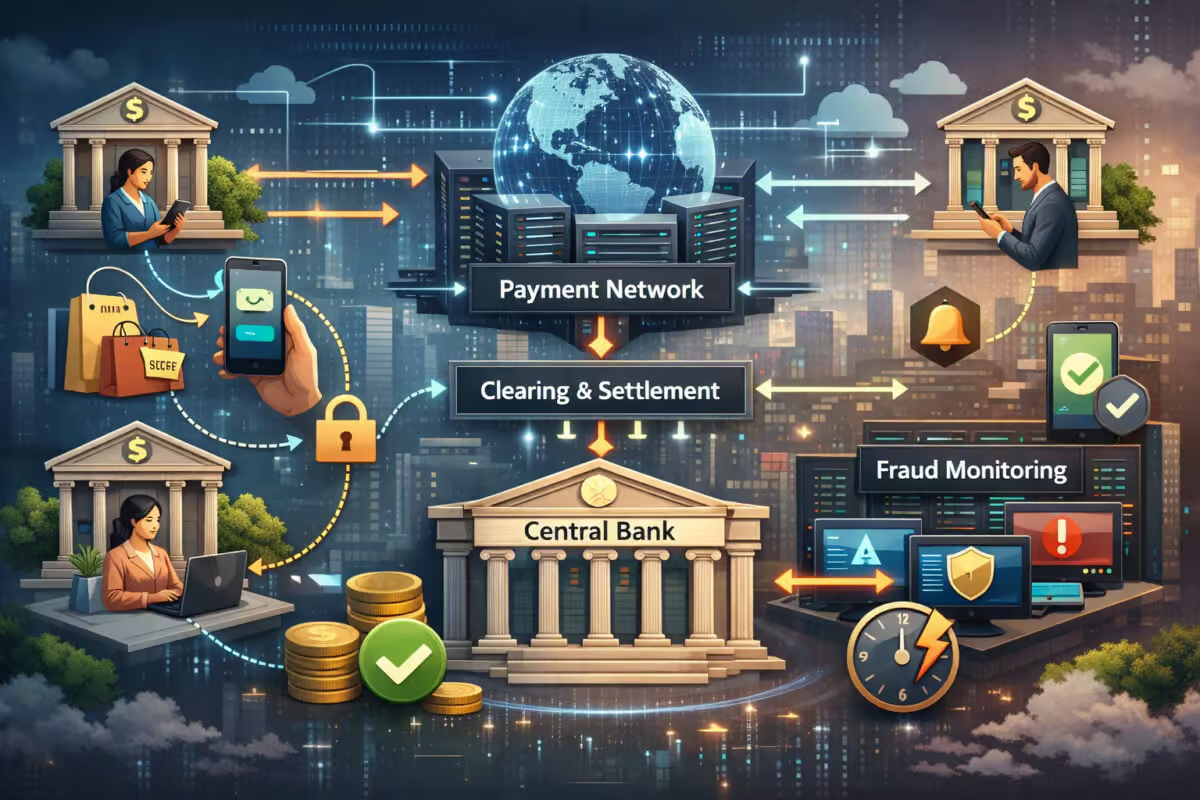
To understand why faster funding matters, it helps to know what normally happens behind the curtain. Payments may feel instant to customers, but the money often moves through several systems before it reaches the merchant.
In a traditional card flow, the customer’s bank, the card network, the payment processor, the acquiring side, and the merchant’s receiving account all play a role. That process includes authorization, batching, clearing, settlement, and deposit timing. Each step can add delay.
Real-time payment settlement compresses or redesigns that path. Instead of waiting for end-of-day batches or next-business-day movement, the system uses modern payment rails or faster payout infrastructure to transmit payment instructions and funds more immediately. This can reduce uncertainty and make liquidity planning much easier for a business.
The specifics vary by payment type, but the idea stays consistent: fewer waiting periods, more direct fund movement, faster confirmation, and quicker access to working capital.
The typical flow in a traditional settlement cycle
In a conventional setup, the merchant accepts the payment first and closes out transactions in a batch later. That batch is then submitted for clearing and settlement. After that, the processor and acquiring side coordinate funding, and the deposit reaches the merchant’s account according to the processor’s timeline and bank cutoffs.
That means several timing factors influence when the merchant actually receives money:
- Time of day the transaction occurred
- Whether the batch was closed promptly
- Weekend or holiday timing
- Processor funding schedule
- Bank posting schedule
- Risk holds or review triggers
Even when everything goes smoothly, there can still be a lag between sale and usable funds. For a business with narrow margins or high operating costs, this delay can create a constant need to bridge the gap with cash reserves.
That is one reason payment settlement time comparison matters so much. Two providers may both say they “process payments fast,” but the true business impact depends on how soon you can actually use the money.
How faster rails and funding programs reduce delays
Modern payment systems reduce delays in a few different ways.
One model uses real-time bank transfer rails, where payment messages and funds move almost immediately between participating institutions.
Another model keeps the front-end payment experience similar but speeds up merchant funding through same-day deposits or expedited payout services. Some platforms also use internal ledgers to credit recipients faster before the final interbank movement completes.
These systems often rely on:
- Continuous processing rather than limited batch windows
- Better messaging standards between institutions
- Faster fraud checks and risk scoring
- Automated reconciliation tools
- Direct connectivity between payment participants
The result is a meaningful shift in cash availability. A merchant might go from waiting one or two business days for standard funding to receiving usable funds within minutes or later the same day.
Where processors and banks fit into the equation
Banks and payment processors are both central to faster settlement. A processor helps route, verify, manage, and reconcile transactions. The receiving bank or financial institution determines how and when the deposit becomes available in the business account.
A processor can only move funds as fast as the payment rail, risk policy, and receiving institution allow. Likewise, a bank may support fast incoming payments, but if the processor batches transactions late or places review holds, the merchant still experiences delays.
This is why fast funding is rarely about one single technology. It is usually a combination of:
- Payment network capability
- Processor infrastructure
- Risk management policy
- Merchant account configuration
- Receiving bank support
When these pieces work together well, a business gets the real benefit of faster payment processing for businesses: more predictable access to cash and fewer operational bottlenecks tied to settlement timing.
Traditional settlement vs instant and same-day settlement

The difference between traditional and fast settlement is not just a matter of convenience. It changes how a business manages daily operations.
In a traditional cycle, funds may arrive one to several business days after the transaction. That delay is often manageable for larger businesses with healthy reserves, but it can be painful for smaller operations or seasonal businesses that need steady cash movement.
When inventory must be restocked quickly or labor must be paid promptly, even a short delay can create pressure.
With same-day payment settlement or instant settlement, the business gets access to funds much faster. That can reduce float-related stress, improve the timing of outgoing payments, and make revenue feel more usable in practice, not just visible on a dashboard.
The real value shows up when you compare how each model affects actual business decisions.
Traditional settlement often creates a cash flow gap
Traditional settlement cycles are built around older processing structures. They tend to rely on batch submission, bank cutoffs, and business-day schedules. That means a payment accepted late in the day, on a weekend, or near a holiday may not become usable for a while.
For some companies, this creates a rolling problem. Money is earned, but it is not yet available. Meanwhile, bills keep coming due. The business may need to delay purchases, use reserves, or rely on credit to cover short-term needs.
This gap can lead to:
- Missed early-payment discounts from suppliers
- Tighter payroll timing
- Delayed inventory restocking
- Reduced flexibility during sales spikes
- More stress when handling surprise expenses
In other words, the issue is not simply how long settlement takes. It is how that timing affects everything else the business needs to do.
Faster settlement improves timing, flexibility, and confidence
Instant or same-day settlement helps by shrinking the gap between earning and using money. That can make the business more responsive and less dependent on buffer cash.
If a retailer has a strong weekend, faster funding can help them reorder top-selling items sooner. If a service business completes a large job, quicker access to funds can help cover subcontractor costs right away. If a platform pays workers or vendors, instant payouts for merchants and recipients can improve trust and reduce payout complaints.
Businesses often notice several immediate advantages:
- Better visibility into actual cash position
- More flexibility in paying vendors
- Faster response to demand changes
- Reduced need for emergency financing
- Less worry around timing mismatches
Even when the dollar amount is the same, having funds sooner can change the way the business operates.
Payment settlement time comparison across common methods
Below is a practical payment settlement time comparison. Exact timing varies by provider, cutoff times, bank support, risk controls, and account setup, but this gives a useful working view.
| Payment Method | Typical Settlement Speed | What Business Owners Should Know |
| Credit and debit cards (standard) | Usually 1–2 business days | Common for many merchants, but timing may stretch based on weekends, batching, or holds |
| Credit and debit cards (expedited funding) | Same day or next day | Often available through selected processors, sometimes for an added fee |
| Standard ACH | Usually 1–3 business days | Lower cost for many transactions, but not ideal when funds are needed quickly |
| Same-day ACH | Same day in eligible windows | Faster than standard ACH, but timing still depends on submission cutoffs |
| Real-time payment rails | Near real time | Best fit when both institutions support the rail and the use case matches |
| Digital wallet transfer to bank | Varies from minutes to 1–3 business days | Instant transfer options may carry extra fees |
| Marketplace or platform payouts | Varies by platform | Some platforms offer instant payout options, while standard payouts may take longer |
| Check deposit | Several days in many cases | Slowest and least predictable for businesses needing fast liquidity |
Why faster payment processing matters for businesses

Revenue timing affects more than accounting. It shapes your ability to operate smoothly.
A business can have healthy sales and still feel pressure if incoming funds arrive too slowly. This is why faster payment processing for businesses is not only a payment issue. It is a working capital issue, a staffing issue, an inventory issue, and sometimes even a customer experience issue.
When settlement speeds improve, businesses often discover that several operational pain points start easing at the same time. Faster incoming money can help stabilize outgoing payments, reduce daily uncertainty, and give owners more room to make smarter decisions.
Faster settlement supports everyday operations
Cash flow is what keeps the lights on between sales cycles. The faster settled money arrives, the easier it becomes to manage the normal rhythm of business obligations.
Think about the typical flow of expenses during a week. You may need to pay for shipping supplies, ad spend, fuel, software subscriptions, contractor invoices, and wages. If your sales are strong but your cash is trapped in slow settlement, you may still feel squeezed.
Faster settlement helps operations because it gives businesses better alignment between income and expenses. Instead of waiting for funds to clear, you can use revenue while it is still relevant to the decisions you need to make.
This is especially valuable in businesses with:
- Tight inventory turns
- Frequent payroll obligations
- Heavy vendor dependence
- Strong weekend sales
- Seasonal swings
- High customer order volume
It reduces the need to borrow against your own sales
One overlooked cost of slow settlement is the need to borrow money just to bridge the gap between completed sales and available funds.
That borrowing may come in the form of a line of credit, a short-term advance, a credit card balance, or personal cash injected by the owner. Even if the gap only lasts a couple of days, repeating that cycle over and over can become expensive and stressful.
By accelerating settlement, a business can reduce how often it needs outside liquidity support. That does not just save financing costs. It also protects decision-making. Owners are less likely to accept poor financing terms when they are not operating from urgency.
It improves planning and visibility
Faster funds make forecasting easier because the money shown in your systems is closer to the money actually available in your account.
That improves confidence in decisions like:
- When to reorder inventory
- Whether to approve overtime
- How much can be spent on marketing
- When to pay suppliers
- Whether a temporary dip really requires financing
When the gap between sale and settlement is smaller, your cash flow picture becomes clearer. That makes the business easier to manage.
How instant payouts for merchants improve cash flow
The strongest case for instant payouts for merchants is simple: speed changes liquidity. Liquidity changes options.
A business with faster access to earned funds can move with less hesitation. It can cover payroll without panic, replenish inventory before stockouts worsen, respond to repair issues quickly, and take advantage of short-lived opportunities. This is how businesses improve cash flow with faster payments in practical, day-to-day ways.
Cash flow is not just about total revenue. It is about whether money is available at the exact moment it is needed. Faster payouts make that timing work in the merchant’s favor.
Faster payouts can smooth out payroll and vendor payments
Payroll is one of the least flexible costs in business. Employees and contractors expect to be paid on time, regardless of when customer funds settle.
The same is true for many vendors. A supplier may require payment before shipping, or they may offer discounts for prompt payment. Slow settlement can force a business to choose between preserving cash and maintaining strong vendor relationships.
When payouts move faster, those choices get easier. Businesses can use current sales to support current obligations instead of constantly planning around delays. That creates a steadier financial rhythm and reduces the sense of operating one step behind.
This is especially valuable for businesses with:
- Weekly payroll cycles
- Large contractor networks
- High material costs
- Frequent replenishment orders
- Strong end-of-week sales that need to support early-week obligations
Faster cash access can support growth decisions
Instant settlement does more than solve short-term pressure. It can also support growth.
Let’s say an online seller notices a product suddenly gaining traction. If funds from yesterday’s sales are already available, the seller can reorder inventory quickly, increase ad spend, and prevent lost sales. If those funds are delayed, the seller may miss the window.
The same idea applies to local service businesses. A contractor with fast access to payment can buy materials for the next job sooner. A restaurant can restock high-demand items without waiting on deposits. A clinic can make urgent supply purchases without disrupting its reserve balance.
In each case, faster settlement increases responsiveness. Growth often depends on timing, and faster payouts improve that timing.
Faster funding can reduce financial stress for owners
Cash flow stress affects decision quality. When owners are constantly watching account balances and waiting for deposits, it becomes harder to focus on growth, service quality, staffing, and strategy.
Faster settlement reduces that mental load. The business feels less fragile because revenue becomes usable sooner. That can improve confidence, reduce fire-drill decision-making, and help owners operate with more discipline.
Benefits of real-time payments for small business and growing companies
Large companies often have more room to absorb timing delays. Smaller and growing businesses usually do not.
That is why real-time payments for small businesses can deliver outsized value. When cash reserves are leaner and operations are more sensitive to timing, settlement speed becomes a strategic advantage. It helps the business stay stable, but it also helps it compete.
Growing businesses, in particular, often experience a strange tension: sales are rising, but the need for cash rises even faster. More orders mean more inventory, more packaging, more labor, and more fulfillment costs. If settlement lags behind this growth, the business can feel stuck even while demand is increasing.
Small businesses benefit because timing matters more
A smaller company may not have a large treasury cushion or an unused credit line ready to absorb every funding gap. It often relies more directly on current revenue to support current expenses.
That makes fast settlement especially useful in situations like:
- Covering day-to-day operating costs
- Paying for inventory in smaller, more frequent orders
- Handling equipment repairs
- Meeting payroll during slower seasons
- Managing fluctuations in customer demand
For these businesses, faster settlement is not a luxury feature. It can be part of basic financial resilience.
Growing businesses need faster movement, not just more sales
Growth creates momentum, but it also creates pressure. Every new order has a cost attached to it. Inventory must be purchased. Labor must be scheduled. Shipping materials must be stocked. Marketing may need to scale.
If incoming cash arrives too slowly, growth can strain the business instead of strengthening it. That is why real-time payment settlement can be particularly useful for businesses moving from early stability into expansion.
Faster access to cash helps support:
- More aggressive inventory cycles
- Faster customer fulfillment
- Better marketing responsiveness
- Stronger supplier relationships
- Better working capital discipline
Real-time funds can improve customer and partner trust
Settlement speed can also affect how a business is perceived.
If you run a marketplace, a service platform, or a multi-vendor business, the ability to pay out recipients quickly matters. People trust platforms more when payments are predictable and fast. Workers, vendors, and sellers are less likely to complain, churn, or delay participation when payout timing meets expectations.
This is one reason faster merchant payouts have become a meaningful differentiator in industries that rely on frequent disbursements.
Use cases where instant settlement delivers the most value
Not every business needs the fastest possible payout for every transaction. But some industries and models benefit from it far more than others.
The more a business depends on rapid turnover, frequent purchases, variable labor, or immediate disbursements, the more valuable instant settlement becomes. In these cases, even modest improvements in funding speed can reduce friction throughout operations.
Retail and ecommerce businesses
Retailers and online sellers often operate on tight margins and fast inventory cycles. Strong sales days create immediate replenishment needs. If best-selling products run out, the business can lose momentum and customer trust.
Faster settlement helps retailers and ecommerce sellers by improving their ability to:
- Reorder popular items quickly
- Pay suppliers faster
- Cover shipping and packaging costs
- Support promotions during demand spikes
- Reduce stockout risk
For ecommerce especially, the timing gap between customer payment and actual deposit can be frustrating because fulfillment expenses begin almost immediately. Faster access to funds narrows that gap.
Service businesses and field-based companies
Service businesses often need to pay technicians, purchase materials, and travel to the next job before the funds from the previous job fully settle.
Plumbers, electricians, consultants, repair companies, cleaning services, and mobile operators all benefit from a faster payment cycle. When a completed job triggers quick settlement, the business can move to the next job with less pressure.
This is useful when a company needs to:
- Buy parts right after finishing a service call
- Pay subcontractors quickly
- Fuel vehicles and cover travel costs
- Keep payroll aligned with actual job volume
Gig economy, platforms, and marketplaces
Businesses that collect money from one side and pay out another side often depend heavily on payout speed. If drivers, sellers, creators, contractors, or providers expect quick access to earnings, slow settlement can become a major pain point.
Instant or same-day payouts can improve retention and trust in these models. They also reduce support requests related to payout timing and make the platform feel more reliable.
Hospitality, food service, and event-based businesses
Restaurants, food trucks, event vendors, and hospitality operators often see concentrated sales periods followed by immediate expense needs. A busy weekend may need to fund fresh inventory, staffing, and prep for the next service period.
Fast settlement helps these businesses turn sales into operating fuel without unnecessary delay.
Potential costs and trade-offs of faster payouts
Faster money is appealing, but it is not always free. Businesses should understand the trade-offs before choosing expedited funding or instant payout options.
The goal is not just to move money faster. It is to move money faster in a way that still makes sense for margins, risk tolerance, and operational needs. In some cases, paying a fee for faster access is worth it. In others, standard settlement may be perfectly adequate.
The best choice depends on how much value you gain from speed compared with what it costs to get it.
Expedited funding may come with added fees
Many processors and platforms charge extra for accelerated deposits or instant transfers. These fees may be fixed, percentage-based, or tied to transaction volume and payout frequency.
That means a business should look beyond the headline promise of faster funding and ask:
- Is there a per-transfer fee?
- Is there a percentage fee?
- Does same-day funding require a premium plan?
- Are there minimum balances or reserve requirements?
- Does every transaction qualify?
A fee may be worthwhile if it helps prevent stockouts, avoid overdrafts, or eliminate short-term borrowing. But if faster settlement is used casually without a clear business reason, the costs can quietly add up.
Risk controls and holds may still apply
Even if a processor advertises fast settlement, not every transaction is guaranteed to fund quickly. Certain payments may trigger review because of size, industry risk, unusual activity, or suspected fraud.
This is important because some businesses assume that enrolling in a fast-funding program eliminates funding delays entirely. In reality, risk checks remain part of the equation. Large ticket sizes, sudden volume spikes, or chargeback concerns can still slow a payout.
That is not necessarily a problem. It is part of maintaining network integrity and reducing losses. But merchants should go in with realistic expectations.
Faster is not always better for every payment type
Sometimes standard settlement is the smarter choice. If the payment is planned, the margin is thin, and the timing is not urgent, paying more for speed may not provide enough benefit.
Businesses often do well with a mixed strategy:
- Use standard settlement for routine transactions
- Use same-day options for cash-intensive periods
- Use instant payouts selectively for high-urgency needs
- Match payment method to the importance of timing
This approach helps preserve margin while still benefiting from speed where it matters most.
How to improve cash flow with faster payments
Faster funding helps most when it is part of a broader cash flow strategy. Businesses that simply switch processors but keep weak cash habits may still struggle. Businesses that combine faster settlement with better planning usually see the strongest results.
To truly improve cash flow with faster payments, you need to connect payout speed to how money is scheduled, tracked, and used across the business.
Match settlement speed to spending patterns
Start by reviewing when your business receives money and when it spends money. The real issue is usually not average monthly revenue. It is timing.
Look at your largest weekly or recurring cash demands:
- Payroll dates
- Supplier due dates
- Rent or lease payments
- Shipping and fulfillment costs
- Marketing spend
- Software and subscription renewals
If settlement timing repeatedly forces you to scramble before these dates, faster funding can solve a real operational problem. If not, a cheaper standard schedule may be enough.
Use multiple payment options strategically
Different payment methods serve different purposes. Some are better for lower cost. Others are better for speed. Businesses often improve cash flow by giving customers more than one way to pay.
For example, a company might accept cards for convenience, encourage ACH for recurring invoices, and use real-time bank payment options for urgent or high-value transactions. That kind of flexibility can improve liquidity without forcing every payment into the same cost structure.
A helpful framework is:
- Optimize for speed when timing matters
- Optimize for cost when urgency is low
- Optimize for reliability across all methods
Tighten reconciliation and forecasting
Faster settlement works best when your bookkeeping and reporting keep up with it. If money arrives quickly but your systems are slow to categorize it, the operational advantage gets diluted.
Businesses should track:
- Expected settlement windows by method
- Deposit timing by processor
- Exceptions or holds
- Fees tied to faster funding
- Net cash available each day
This creates a clearer picture of working capital and makes it easier to decide when fast payouts are worth using.
For businesses looking to understand the mechanics and benefits of bank-based transfers, this overview of ACH payment processing and how it works can be useful context.
Common challenges and limitations of instant settlement
Instant settlement is powerful, but it is not universal. Business owners should understand where the limits are so they can plan around them.
A fast settlement product may still depend on bank compatibility, transaction eligibility, processing windows, or risk rules. Some payment types simply do not move at the same speed as others. In addition, “instant” can mean different things across providers, which makes comparison harder.
The key is to view instant settlement as an important tool, not a magic switch.
Not every bank, account, or payment type supports real-time movement
Real-time payment systems depend on participating institutions and supported account types. If one side of the transaction does not support the rail or if the processor cannot route the payment that way, settlement may fall back to a slower option.
This can affect businesses that assume all faster payment claims work the same everywhere. In practice, availability depends on the network, the banks involved, and the provider’s payout setup.
Even within the same provider, one payout method may settle instantly while another follows a same-day or next-day schedule.
Weekends, cutoffs, and holds can still matter
Although modern payment systems reduce delays, some constraints remain. Cutoff times, maintenance windows, review triggers, and internal policies can still affect when funds become available.
This is especially true for merchants with:
- New accounts
- High-risk profiles
- Sudden spikes in volume
- Large average ticket sizes
- Elevated chargeback activity
A processor may still delay or review funds even if the underlying platform supports faster settlement. Business owners should ask about exceptions, not just best-case timelines.
Faster funds do not replace good cash management
One common mistake is assuming fast settlement will automatically solve all liquidity problems. It helps, but it does not replace pricing discipline, expense control, margin management, or forecasting.
If a business consistently spends beyond its means, faster deposits may only speed up the cycle of cash strain. The best results come when instant settlement supports a business that already has strong operational habits.
For businesses comparing modern processing options more broadly, this resource on custom payment processing solutions for business needs offers a helpful lens on how settlement speed fits into the bigger payment infrastructure decision.
Tips for choosing the right payment processor that supports faster payouts
Not all processors offering fast funding are equally strong. Some provide true real-time capabilities in the right use cases. Others offer same-day deposits under narrow conditions. Some rely heavily on marketing language that sounds faster than the actual funding experience.
Choosing the right provider means looking past the headline and evaluating how the payout model works in real-world business conditions.
Ask precise questions about funding speed
When comparing providers, ask very specific questions. General promises like “fast deposits” or “quick funding” do not tell you enough.
Better questions include:
- What is the standard funding timeline?
- What is the same-day option?
- What is the instant payout option?
- Which payment methods qualify?
- What are the cutoff times?
- Are weekends included?
- What fees apply?
- Under what conditions can funds be delayed?
The clearer these answers are, the easier it is to compare true value.
Review compatibility with your business model
A processor that works well for a retail store may not be ideal for a contractor, platform, subscription business, or ecommerce seller. Settlement needs differ by industry and cash flow pattern.
Look for a provider whose payout options align with how your business actually operates. If you invoice high-ticket jobs, ACH and bank rails may matter more. If you run a high-volume storefront, card settlement and batch timing may matter more. If you pay out sellers or contractors, recipient funding tools become critical.
Consider support, transparency, and reporting
Faster funding is only useful if the system is understandable. Good reporting, clear fee disclosure, and responsive support matter just as much as speed.
You should be able to answer questions like:
- Which deposits came from which transactions?
- Why was a payout delayed?
- What fees were charged for faster funding?
- What options do I have if my funding pattern changes?
A processor that offers speed without visibility may create new confusion even while solving the old delay problem.
Best practices for managing cash flow with different settlement speeds
Once a business has access to multiple funding speeds, the next step is using them intelligently. Instant, same-day, and standard funding each have a place.
The goal is to design a payment strategy that supports healthy operations without unnecessarily increasing cost. That means thinking about settlement speed as one lever among many in cash flow management.
Build a payment mix instead of relying on one option
Many businesses get the best results from using a blend of payment methods and payout speeds rather than treating one method as the answer to every need.
For example:
- Use standard funding for predictable recurring revenue
- Use same-day settlement for weekly cash crunch periods
- Use real-time rails for urgent business-to-business transfers
- Use instant payout features selectively when timing is critical
This layered approach helps balance cost, flexibility, and reliability.
Keep a buffer even if you have fast settlement
Fast settlement is helpful, but it should not become a reason to operate with zero cushion. Unexpected holds, bank outages, processor reviews, or chargebacks can still happen.
Maintaining a cash buffer protects the business from treating fast funding as guaranteed in all situations. It also allows owners to use fast payout tools strategically instead of out of desperation.
A practical rule is to view instant settlement as a support system, not your only safety net.
Monitor net benefit, not just gross speed
Businesses sometimes focus so heavily on how fast funds arrive that they forget to measure whether faster access is actually improving financial outcomes.
Track questions like:
- Did faster settlement reduce overdrafts?
- Did it help secure supplier discounts?
- Did it prevent stockouts?
- Did it reduce short-term borrowing?
- Did payout fees stay reasonable relative to the benefit?
This helps turn settlement speed into a measurable operational choice rather than a vague convenience feature
Conclusion
Instant payment settlement matters because timing matters.
For business owners, the difference between “payment received” and “money available” can shape everything from payroll confidence to inventory planning to stress levels at the end of the week.
Faster settlement does not change your revenue by itself, but it changes how quickly that revenue becomes useful. That can have a very real effect on liquidity, flexibility, and day-to-day stability.
Traditional settlement timelines still have a place, especially when cost efficiency matters more than speed. But for many businesses, real-time payment settlement, same-day payment settlement, and other forms of faster payment processing for businesses can unlock smoother operations and better working capital control.
The biggest gains often come from using faster funding intentionally, where it solves real timing problems.
If you want to improve cash flow with faster payments, start by reviewing your current settlement timelines, expense calendar, and biggest pressure points. Then compare payment methods, ask better questions about funding speed, and choose a setup that matches how your business actually runs.
When your money moves closer to the speed of your operations, the business becomes easier to manage, easier to grow, and better prepared for what comes next.