
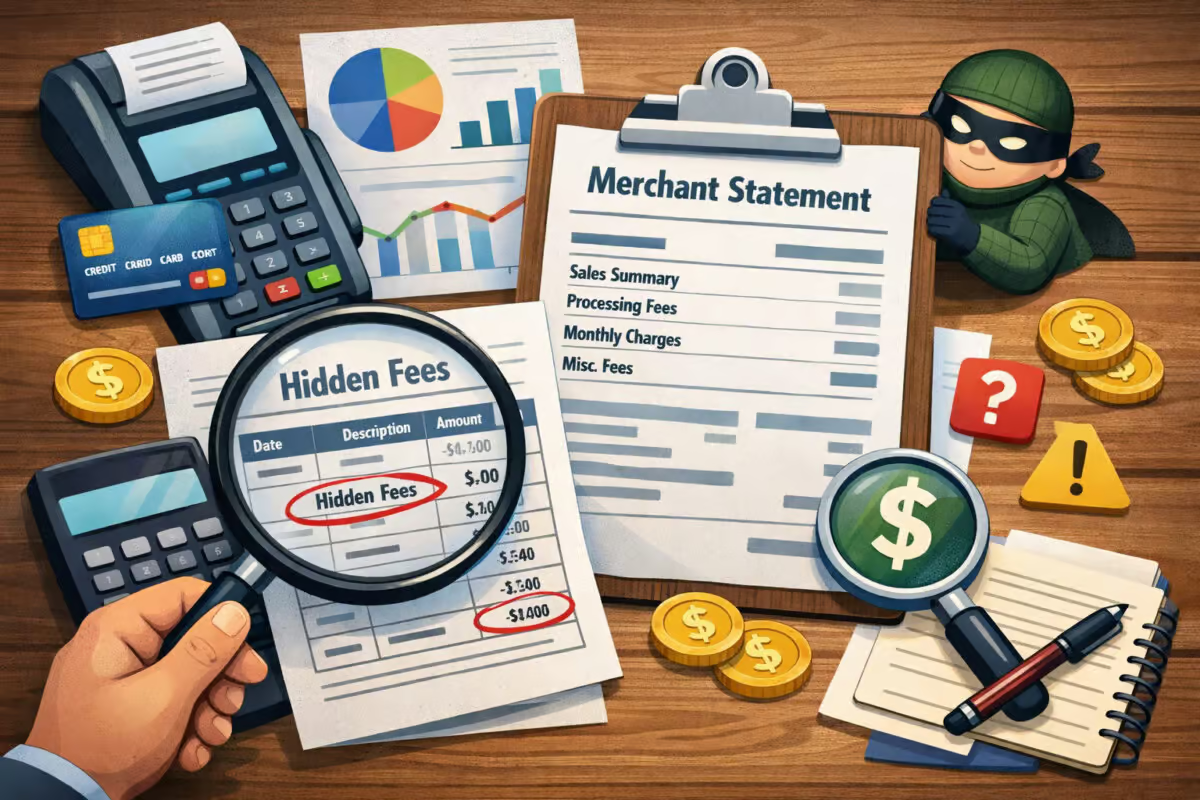
Many businesses overpay for card acceptance for one simple reason: they never learn how to read a merchant statement. The statement arrives each month, looks technical, and gets filed away without much attention. Meanwhile, small charges stack up, pricing changes slip through, and fees that seemed minor at first quietly chip away at profit.
That is why learning to read a merchant statement matters so much. A merchant statement is not just a billing summary. It is a record of what you processed, what you were charged, and how your provider structured those charges.
When you understand it, you can catch errors, question vague fees, compare providers more accurately, and make smarter decisions about pricing.
This guide walks through the full process in a practical way. You will learn what a merchant statement is, how a credit card processing statement is structured, how to interpret common line items, and how to spot hidden fees in a merchant account before they become a long-term drain.
You will also learn how to perform a simple merchant services statement analysis, how to audit merchant statement details step by step, and what questions to ask when something does not look right.
If your statement has ever felt confusing, overwhelming, or impossible to decode, you are not alone. Once you know what to look for, it becomes much easier to separate necessary costs from questionable charges and take control of your processing expenses.
What a Merchant Statement Really Is
A merchant statement is the monthly report that shows your payment processing activity and the fees tied to that activity. It usually includes your card sales volume, number of transactions, refunds, chargebacks, processing rates, monthly service charges, and any additional account fees.
In many cases, it also shows how those fees were calculated, although some statements do a much better job of that than others.
At first glance, a merchant statement can feel overly detailed. That is because it combines operational data and billing data in one place. You are not only seeing what your customers paid, but also how the processor, acquiring bank, and card networks allocated costs across your account.
This is why a merchant statement explained properly can save a business real money. It turns an opaque invoice into a tool for cost control.
A typical credit card processing statement may include separate sections for deposit activity, interchange categories, assessments, processor markup, monthly recurring fees, dispute activity, and adjustments.
Some providers also include reserve balances, PCI-related charges, equipment fees, and annual account fees. When these items are bundled together without clear labels, business owners often miss important details.
This is also why statements should never be reviewed only when something goes wrong. If you wait until costs rise dramatically, you may discover that the issue has been sitting there for months.
A careful statement fee review helps you catch problems earlier and build a clearer picture of your true payment acceptance cost.
Why So Many Business Owners Ignore It
One reason many owners avoid their statement is that the terminology feels unfamiliar. Terms such as basis points, nonqualified surcharge, network assessment, downgrade, PCI noncompliance, and retrieval fee do not mean much to someone focused on running daily operations. If the provider uses inconsistent labels or abbreviations, the confusion gets worse.
Another reason is that most statements are designed for accounting records, not for easy reading. They often group important fees into broad categories or scatter them across multiple pages.
A monthly minimum may appear in one section, a gateway fee in another, and an annual account charge on a later page. Without context, it is hard to tell what is normal and what deserves review.
There is also a mindset issue. Many businesses assume that payment processing is too complex to question. They expect some level of mystery and treat fees as fixed. In reality, many charges are negotiable, avoidable, or at least worth examining more closely.
That is where merchant account statement guide habits become valuable. Once you know the structure, the statement becomes much easier to interpret.
Why Your Statement Is One of Your Best Financial Tools
Your merchant statement tells you more than your monthly bill. It can reveal whether your pricing model matches your business type, whether your transactions are downgrading into more expensive categories, and whether your provider is adding fees that were never clearly discussed.
It can even show operational issues, such as duplicate batching, excessive manual entry, or a high volume of keyed transactions that drive up cost.
It also helps you compare providers on a more realistic basis. Many businesses switch based on a quoted rate, then discover later that the new provider has separate monthly fees, annual fees, compliance charges, statement fees, gateway fees, and incidental fees that make the deal less attractive than it first appeared. A real merchant services statement analysis looks beyond the headline rate and focuses on total effective cost.
In short, if you want to understand what you are really paying for card acceptance, your monthly statement is the starting point.
Why You Should Review Your Merchant Statement Regularly
Reviewing your statement every month is one of the simplest ways to protect your margins. Even a quick review can reveal unusual changes before they turn into a recurring expense.
Because payment processing costs often appear in small increments, they can be easy to overlook. A new fee might add only a few dollars at first, but over time those small charges can add up to hundreds or thousands.
Regular review also helps you catch pricing drift. Providers sometimes update fee schedules, adjust account terms, or add new charges that blend into the statement format.
If you are not reviewing the details, those changes may continue for months without challenge. This is especially important if you are on tiered pricing, flat-rate pricing with exceptions, or an older merchant account with legacy fee structures.
A good habit is to compare this month’s statement against the prior two or three months. Look for changes in total fees, effective rate, monthly recurring charges, and new fee descriptions. This does not require a full audit every month. Even a short routine check can help you spot hidden fees merchant account holders often miss.
Another reason to review statements regularly is to confirm that your transaction patterns align with your pricing. For example, if your business does mostly card-present sales but your statement shows a surprisingly high cost per transaction, something may be off.
You may be seeing downgrades, excessive keyed entries, higher-risk categorization, or a markup that is larger than expected.
The Cost of Letting Statements Pile Up
When businesses ignore statements for long periods, they lose visibility into how their account behaves over time. A fee that appears only once may not be serious. A fee that appears every month for a full year is a different story. Without regular review, it becomes much harder to identify patterns.
Delayed review also weakens your position when disputing charges. If you question a fee six or eight months later, the provider may argue that the charge was disclosed earlier or that it reflects an already implemented pricing change.
Reviewing each statement promptly makes it easier to document when a fee first appeared and whether it was previously disclosed.
There is also the practical issue of budget accuracy. If your accounting team books payment processing as a single lump expense without understanding what is inside it, you may miss opportunities to reduce cost.
A payment processing fees breakdown can reveal which charges are tied to volume, which are fixed, and which are unexpected. That makes forecasting and decision-making much stronger.
What Regular Review Helps You Catch
A monthly statement review can help you catch issues such as:
- Duplicate monthly fees
- Unexpected PCI-related charges
- Statement or account fees that were not discussed
- Increased processor markup
- Excessive downgrade or nonqualified charges
- Unusual chargeback or retrieval fees
- Monthly minimums that keep hitting because of low volume
- Equipment, gateway, or software fees that no longer apply
- Batch fees that are higher than expected because of processing habits
- Annual or quarterly fees that were easy to miss in prior months
Even if every charge is technically valid, reviewing the statement lets you ask a more important question: is this account still a good fit for your business? That is where ongoing statement fee review becomes more than bookkeeping. It becomes part of cost management.
How a Credit Card Processing Statement Is Usually Structured
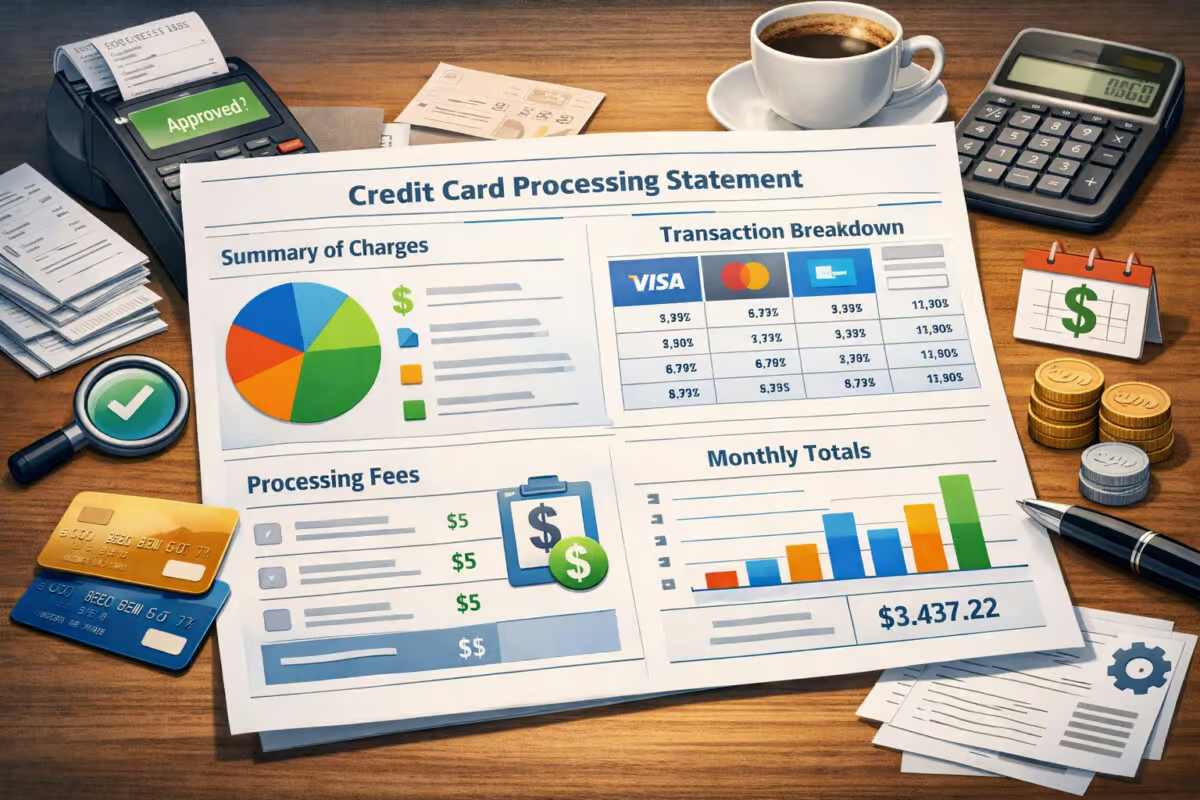
Most merchant statements follow a broad pattern, even though the layout, terminology, and level of detail vary by provider. Once you understand the typical structure, it becomes easier to read a merchant statement without getting lost in the formatting.
Most statements begin with account information and summary totals. This area may include your merchant ID, statement period, deposit totals, sales volume, refund activity, number of transactions, and total fees deducted. This is the high-level snapshot, but it is only the beginning. To understand what you are actually paying, you need to go deeper.
After the summary, many statements break charges into fee categories. These often include interchange, card brand assessments, processor markup, monthly account fees, PCI charges, equipment or gateway fees, chargebacks, and miscellaneous adjustments. Some providers group these clearly. Others scatter them across several pages with abbreviated labels.
A separate section often covers transaction details. This may show the number of qualified, mid-qualified, or nonqualified transactions if you are on tiered pricing, or it may list interchange categories if you are on interchange-plus pricing.
In either case, the goal is the same: to show how your sales volume was categorized and what cost was attached to each group.
At the end, you may find special items such as reserve activity, regulatory fees, annual renewal fees, chargeback administration fees, and incidental charges. These often receive the least attention because they appear after the main sections. But they are also where hidden merchant fees sometimes show up.
The challenge is not just reading each section. It is understanding how the sections connect. Your statement should tell a consistent story: how much you processed, how those transactions were classified, what base costs applied, what markup was added, and what extra fees were charged on top.
The Main Sections You Will Usually See
Below is a practical breakdown of the sections most business owners encounter on a merchant statement:
| Statement Section | What It Usually Includes | Why It Matters | Deserves Extra Review? |
| Account Summary | Total sales, refunds, net deposits, total fees | Gives the big-picture cost snapshot | Yes |
| Transaction Summary | Number of transactions, average ticket, card mix | Helps explain fee patterns | Yes |
| Interchange Fees | Base transaction costs by card type and method | Often the largest cost component | Yes |
| Assessments | Card brand fees charged on processed volume | Usually non-negotiable but should be visible | Yes |
| Processor Markup | Provider’s percentage, per-item fee, basis points | This is where pricing differences show up | Yes |
| Monthly Fees | Statement fee, PCI fee, gateway fee, monthly minimum | Easy place for unnecessary charges to hide | Yes |
| Chargeback/Dispute Fees | Chargeback, retrieval, representment charges | Important for risk and cost control | Yes |
| Incidental or Miscellaneous Fees | Batch fees, AVS, voice auth, file fee, annual fee | Often overlooked because charges look small | Yes |
This kind of table is useful because it helps you understand what is routine versus what deserves questioning. Not every fee is suspicious, but every fee should be understandable.
Why Different Providers Make Statements Easier or Harder to Read
Statement readability often depends on the pricing model and the provider’s reporting style. Interchange-plus statements can look more detailed because they separate underlying costs from markup. Tiered statements may look simpler on the surface, but they can make it harder to understand why some transactions cost much more than others.
Some providers provide strong fee transparency with clearly named sections and line-item detail. Others use abbreviated codes, grouped pricing categories, or bundled charges that make comparison difficult. Resources that explain payment processing fees and interchange fees can help you understand what the labels on your own statement are trying to show.
A readable statement is not just a convenience. It is often a sign of pricing transparency. When the provider makes it easy to see the fee structure, it becomes easier to review, question, and compare.
Merchant Statement Explained: The Core Fee Categories You Need to Understand

If you want to read a merchant statement effectively, you need to understand the major fee categories that appear on it. Once you can separate base card costs from processor-added charges, the statement becomes much less intimidating.
At the highest level, your fees usually fall into three groups. First, there are card networks and issuing bank costs, often shown as interchange and assessments.
Second, there is the processor’s markup, which includes the provider’s percentage, per-transaction charge, or basis-point markup. Third, there are monthly and incidental fees, such as PCI-related charges, gateway fees, statement fees, batch fees, and chargeback administration fees.
Many business owners focus only on the percentage rate, but that does not tell the full story. Your total cost can rise because of small fixed fees, a monthly minimum, downgrade categories, or add-on services attached to the account. That is why a payment processing fees breakdown is more useful than a single advertised rate.
When you review the statement, ask two questions for every line item: what is this fee for, and is it based on my sales activity or on my account setup? Fees tied to activity may change with transaction volume or card mix. Fees tied to account setup tend to recur whether your volume is high or low.
Interchange Fees
Interchange is usually the largest part of your processing cost. It is the base fee associated with card transactions and varies depending on the card type, how the card was accepted, the industry, the risk profile, and whether all required transaction data was captured.
Premium rewards cards, manually keyed entries, and some eCommerce transactions may cost more than basic debit or standard consumer card transactions.
Resources discussing interchange fees and merchant services fee structures explain that these charges vary by card type and transaction conditions, which is why statements often show multiple interchange categories rather than one flat line.
On an interchange-plus statement, you will often see many separate interchange categories. That can look overwhelming, but it is actually helpful because it shows how transactions were classified.
On a tiered statement, interchange may be hidden inside broader buckets such as qualified or nonqualified, making it harder to see what drove cost.
Interchange itself is not usually negotiable in the way processor markup is. What is negotiable is how much the processor adds on top and whether your setup helps transactions qualify for the best available categories. If your statement shows unusually expensive categories appearing often, that deserves review.
Assessments and Network Fees
Assessments are card brand fees applied to processed volume and sometimes to individual transactions. These are different from interchange. They are typically set by the networks and passed through by the provider.
Depending on the statement format, they may appear as network fees, association fees, dues and assessments, NABU fees, APF, or similar labels.
Because the names vary, these fees can be confusing. Many business owners assume they are processor-created charges when they are actually pass-through costs. Still, they should be visible and clearly identified. If your statement lumps them together without explanation, ask for a more detailed fee breakdown.
These costs are part of normal processing, but you should still review them for consistency. If the network fee section changes suddenly or seems much higher relative to volume, it may indicate a reporting change, a change in transaction mix, or another factor worth examining.
Processor Markup
This is the portion of the cost where providers differ most. Markup may appear as a percentage over interchange, basis points, a per-item fee, a monthly service fee, or all of these combined. On some statements, markup is clearly separated. On others, it is buried in pricing tiers or blended categories.
The reason markup matters is simple: it is where you have the most room to negotiate. Two providers may pass through the same interchange and assessments, but one may add a much larger markup or more recurring account fees.
A solid merchant services statement analysis focuses heavily on markup because it shows the true cost difference between providers.
If your markup is difficult to locate, that is already useful information. Lack of clarity often makes overbilling harder to spot. A provider that cannot explain its own markup in a straightforward way deserves closer scrutiny.
Understanding Monthly Charges, PCI Fees, Batch Fees, and Other Add-Ons
Not all charges on a merchant statement are tied directly to a specific transaction. Many are recurring account-level fees that appear every month, every quarter, or once a year. These fixed charges are especially important because they affect your cost even during slower sales periods.
Monthly charges may include statement fees, gateway fees, platform fees, customer support fees, monthly minimums, PCI program fees, account maintenance fees, and equipment rental charges. Some of these can be legitimate. Others may be outdated, duplicative, or poorly explained.
This is one of the most important parts of a merchant statement explained in practical terms. Many businesses focus on transaction rates and ignore monthly fees, even though those fixed charges can make a major difference, especially for lower-volume merchants.
A provider with a slightly better percentage rate may still cost more overall if the account is loaded with recurring charges.
A good statement fee review should separate these charges from transaction costs. That makes it easier to ask whether each fee still serves a purpose. If a gateway is no longer in use, if paper statements are no longer needed, or if a compliance fee is being paired with a separate noncompliance penalty, those are all points worth raising.
For general background on common fee structures, merchant services fees and broader cost-optimization resources covering payment processing cost optimization can help clarify which costs are core processing charges and which are provider-added account expenses.
PCI Fees and PCI Noncompliance Charges
PCI-related charges are among the most misunderstood items on a merchant statement. Some providers charge a monthly or annual PCI program fee tied to security tools, compliance support, or scanning services. Others charge a separate PCI noncompliance fee when the merchant has not completed required steps.
Guidance on PCI compliance checks for your merchant account explains that PCI compliance requirements exist to protect cardholder data and that merchants can face penalties or added costs when compliance steps are incomplete.
The key issue is transparency. If you are paying for PCI support, you should know exactly what that includes. If you are being charged a noncompliance fee, you should know what action will remove it. Problems arise when businesses pay both without clear explanation or continue paying penalties after they have already completed the required process.
When reviewing these items, ask whether the fee is recurring, what service it covers, and whether you can opt out by completing a compliance questionnaire or using a validated setup. PCI charges may be legitimate, but they should never be mysterious.
Batch Fees, Monthly Minimums, and Miscellaneous Charges
Batch fees are typically charged each time you close out your terminal or submit a batch of transactions. On their own, they may seem small. But if your system is batching too often, or if multiple terminals are closing separately, the cost can add up. This is one reason operational habits matter when reading a statement.
Monthly minimums can also surprise merchants. A monthly minimum means that if your processing fees do not reach a certain threshold, the provider charges the difference. This may not be a problem for a high-volume business, but for seasonal or low-volume merchants, it can become a recurring annoyance.
Miscellaneous charges deserve even more attention. These may include AVS fees, voice authorization fees, file fees, annual fees, inactivity fees, regulatory product fees, or technical support fees. Small charges like these are often where hidden merchant fees live because they are easy to ignore and difficult to evaluate without context.
How Pricing Models Affect Statement Readability
One reason business owners struggle to read a merchant statement is that the pricing model changes what the statement looks like. Two businesses with similar sales volume may receive statements that look completely different simply because their accounts are priced differently.
The three most common pricing structures are interchange-plus, tiered pricing, and flat-rate pricing. Each has advantages and drawbacks, but they do not offer the same level of visibility. If your goal is to audit merchant statement details and understand exactly what you are paying, the pricing model matters a lot.
Interchange-plus is often the easiest model for detailed review because it separates underlying interchange and assessment costs from processor markup. It may create a longer, more detailed statement, but that detail is useful. You can see whether costs rose because of card mix, volume, or processor-added markup.
Tiered pricing groups transactions into pricing buckets such as qualified, mid-qualified, and nonqualified. While this can look simpler, it often hides the reasons behind cost differences. Why one transaction landed in a more expensive bucket may not be obvious from the statement alone.
Flat-rate pricing can be straightforward for simple processing setups, especially if the provider uses a single published rate with minimal extra fees. However, even flat-rate accounts can include chargeback fees, gateway costs, PCI charges, or payout-related fees outside the advertised transaction rate.
Interchange-Plus: More Detail, More Clarity
Interchange-plus statements usually show the most detail. You may see many line items tied to specific card categories, transaction methods, and assessment types. At first that can feel like too much information, but it is often the best structure for merchant account statement guide purposes because it shows the moving parts clearly.
With interchange-plus, you can typically identify three layers: the interchange cost, the assessments, and the provider’s markup. That makes it easier to compare providers and easier to spot markup increases. It also lets you see whether operational changes, such as better data capture or fewer keyed entries, are improving your cost structure.
This model tends to reward businesses that want transparency and are willing to look at the details. If you are serious about merchant services statement analysis, this structure often gives you the best visibility.
Tiered and Flat-Rate Statements: Simpler on the Surface, Harder to Audit
Tiered pricing is often harder to evaluate because the statement may not show why a transaction was assigned to a more expensive category. If many transactions are being classified as mid-qualified or nonqualified, your cost can rise quickly without a clear explanation on the statement itself.
That does not mean tiered pricing is automatically bad. But it does mean businesses should review it carefully. If you cannot tell what drove the cost, you have less control over it. This is where many merchants struggle to spot hidden fees merchant account agreements can conceal behind broad pricing labels.
Flat-rate models can be easier to understand for small businesses with simple needs, but statement analysis should still include recurring fees and non-transaction charges. A flat rate is only simple if the rest of the account is simple too.
If the statement includes platform fees, instant funding fees, chargeback fees, statement fees, and account service charges, the simplicity starts to fade.
How to Perform a Basic Merchant Services Statement Analysis
A merchant services statement analysis does not have to be complex. You do not need to be an accountant or payment processing expert to identify the biggest cost drivers on your statement. The goal is to move from confusion to clarity by reviewing the statement in a logical order.
Start with the account summary. Note the total sales volume, total number of transactions, refunds, and total fees charged. Then calculate your effective rate by dividing total fees by total processed volume.
This gives you a quick percentage that helps you compare one month to another. It is not a perfect measurement, but it is useful as a first check.
Next, separate your costs into categories: interchange, assessments, processor markup, monthly fees, and incidental fees. If the statement does not present them that way, make your own notes. This step alone can reveal whether your cost issue is mostly transactional or mostly administrative.
Then compare the current statement to previous months. Look for new line items, changed fee amounts, or unusual jumps in categories that are usually stable. If batch fees suddenly doubled or a PCI fee appeared without notice, you have a clear follow-up point.
You should also review the transaction mix. Are more transactions being keyed? Are you seeing more expensive card categories? Are chargebacks increasing? A basic analysis should connect cost changes to activity changes where possible.
Step 1: Measure the Effective Rate the Right Way
Your effective rate is one of the fastest ways to assess whether your costs are moving in the wrong direction. To calculate it, divide total fees by total card volume for the statement period. This gives you a blended percentage showing what you effectively paid overall.
That number should not be used in isolation. A business with many low-ticket transactions may naturally have a different effective rate than a business with large average tickets. Card-not-present businesses may also see different results than card-present merchants. Still, the effective rate is useful for trend tracking.
If the effective rate rises meaningfully from one statement to the next without a major shift in your business, something deserves review. It could be a markup change, more downgrades, more monthly fees, or a change in transaction mix. The effective rate does not tell you the cause, but it tells you where to start looking.
Step 2: Separate Normal Costs From Questionable Costs
Once you know the total cost, go line by line and sort fees into three buckets:
- Expected base costs
- Provider-added recurring fees
- Unclear or questionable charges
Expected base costs include interchange and network assessments. Provider-added recurring fees include statement fees, gateway fees, PCI program fees, and monthly account fees. Unclear charges are anything you cannot identify quickly, anything newly added, or anything that seems inconsistent with your agreement.
This is where many businesses first notice hidden merchant fees. The issue is not always that the fee is improper. Sometimes the bigger problem is that it is poorly disclosed, duplicated, or no longer relevant to how the account is used.
How to Spot Hidden Fees in a Merchant Account
To spot hidden fees merchant account statements may contain, you need to know what “hidden” really means. Hidden fees are not always completely invisible. More often, they are disclosed in a way that is easy to overlook, hard to understand, or buried among routine charges.
A fee may be hidden because the label is vague. It may appear as “regulatory product fee,” “service package,” “account enhancement,” or “program fee” without any explanation. It may also be hidden because it is small enough that few merchants challenge it. A three-dollar or five-dollar charge rarely triggers alarm, but repeated month after month it becomes meaningful.
Another common hidden-fee pattern is duplication. A business may pay a gateway fee and a platform fee for overlapping services, or both a PCI program fee and a PCI noncompliance fee without realizing it.
In some cases, a merchant who no longer uses a terminal may still be paying equipment-related fees. These are the kinds of details a close statement fee review can uncover.
Some statements also hide fees through timing. Annual fees, quarterly fees, or one-time administrative fees may appear only occasionally. If you only review statements casually, they can slip through unnoticed. That is why hidden merchant fees are often easiest to catch by comparing several months at once.
For a broader overview of the types of costs that can quietly affect margins, articles about hidden processing fees and merchant fee management show how small statement charges can accumulate when businesses do not monitor them closely.
Common Hidden or Overlooked Fees
The following charges deserve closer inspection whenever they appear:
- Statement fee
- Monthly minimum fee
- PCI noncompliance fee
- Annual account fee
- Gateway or platform fee
- Batch fee
- AVS fee
- Chargeback administration fee
- Retrieval fee
- File transmission fee
- IRS reporting or regulatory support fee
- Equipment lease or maintenance fee
- Customer service or help desk fee
- Inactivity fee
- Early termination-related billing
These charges are not automatically improper. The point is that they should be clearly explained and consistent with your agreement. If they are not, they belong on your review list.
Red Flags That Suggest Non-Transparent Pricing
Certain patterns should make you pause during a merchant account statement guide review. One red flag is a fee label that gives you no meaningful clue about what the fee covers. Another is a charge that appears suddenly without any corresponding change in volume, equipment, or service.
Other warning signs include:
- Markup that is difficult to identify anywhere on the statement
- Many small monthly charges instead of one transparent service fee
- High nonqualified volume on a tiered statement without explanation
- Recurring noncompliance charges even after taking corrective steps
- Paper statement fees when you receive statements electronically
- Fees tied to services you no longer use
- Costs that do not match what you were originally quoted
If your provider cannot explain a fee in a direct, specific way, that is a problem. Transparency does not mean every fee is low. It means every fee is understandable.
Common Confusing Terms You May See on a Merchant Statement
One of the hardest parts of learning to read a merchant statement is the terminology. Providers often use abbreviations, legacy labels, or industry shorthand that make routine charges look more mysterious than they really are. Understanding these terms is a big part of making the statement readable.
You may see references to discount rate, authorization fee, basis points, downgrade, assessment, interchange category, retrieval, reserve, monthly minimum, nonqualified surcharge, AVS, and chargeback representation. If those terms are not familiar, the statement can feel like it was written for someone else.
The good news is that most confusing terms fall into repeatable patterns. Some describe how the transaction was priced. Others describe what happened after the transaction, such as disputes or reversals. Still others refer to account services or compliance obligations. Once you know which category a term belongs to, it becomes easier to interpret.
This is where a merchant statement explaining an article becomes especially useful. The problem is often not the fee itself but the language used to present it. When a statement uses technical shorthand without context, it becomes harder for businesses to challenge costs confidently.
A Quick Glossary for Common Statement Terms
Here are a few terms that often cause confusion:
- Discount rate: A general term for the percentage charged on transactions. It may not represent the full cost.
- Basis points: One basis point equals one one-hundredth of a percent. Providers often quote markup this way.
- Authorization fee: A fee tied to obtaining approval for a transaction.
- AVS fee: A charge for address verification, often used in card-not-present transactions.
- Retrieval fee: A fee when transaction information is requested during a dispute inquiry.
- Chargeback fee: An administrative fee assessed when a customer dispute becomes a chargeback.
- Batch fee: A charge applied when a batch of transactions is settled.
- Monthly minimum: A fee charged when account fees do not reach a required threshold.
- Reserve: Funds held back as protection against risk or potential losses.
- Downgrade: A transaction that qualified for a more expensive pricing category because certain conditions were not met.
When you see one of these terms, do not assume it is wrong. But make sure you understand how it applies to your account.
Why Terminology Matters in Cost Control
Confusing language benefits nobody except the party trying to avoid scrutiny. If you do not understand what a line item means, you are less likely to question it. That is why learning vocabulary is not just educational. It is a practical cost-control step.
Over time, you will notice that many providers describe similar charges in different ways. That is another reason comparison shopping can be difficult. One statement may say “association fees,” another may say “network access,” and another may list several codes instead. A smart statement fee review focuses on what the charge does, not just what it is called.
How to Audit a Merchant Statement Step by Step
If you want to audit merchant statement details without getting overwhelmed, follow a simple step-by-step process. This works whether you are reviewing one statement or several months at once.
First, gather the statement, your original pricing agreement or proposal, and at least two prior statements. Having all three lets you compare what you were promised with what you are actually paying. It also helps you see whether the current statement reflects a one-time issue or a pattern.
Second, identify your total processed volume and total fees. Calculate the effective rate. Then list every recurring monthly fee separately. This gives you a clean starting point before you get lost in line-item detail.
Third, review the transactional section. If you are on interchange-plus, look at interchange categories and markup. If you are on tiered pricing, see how much volume is falling into each tier. If a large share of your transactions are priced in the most expensive bucket, ask why.
Fourth, scan for new, vague, or duplicate fees. Mark any line item you do not recognize. Then compare it to prior months and to your agreement. If it is new, ask when it was added and why. If it was always there, ask why it was never clearly explained.
Fifth, review operational fees and dispute-related charges. Are you paying too many batch fees because of batching habits? Are retrievals or chargebacks rising? Is PCI noncompliance still appearing? These are often solvable issues once identified.
Finally, prepare a short list of questions for your provider. Keep them specific. Ask what the fee is, when it began, whether it is avoidable, and whether it was part of the original agreement.
What Documents to Compare During an Audit
A useful audit compares more than just one monthly statement. Ideally, you should compare:
- The current statement
- Two to six prior statements
- Your merchant application or pricing schedule
- Any email quote or proposal you accepted
- Equipment or gateway agreements
- PCI program documentation if relevant
This comparison helps you identify whether a charge is new, seasonal, disclosed, or duplicated. It also helps you distinguish between an expected pass-through change and an unexplained provider-added fee.
The more complete your documentation, the easier it is to challenge unclear costs. Even if you do not have every original document, comparing statements over time can still reveal enough to start the conversation.
Questions to Ask When a Fee Is Unclear
When you contact your provider, ask direct questions such as:
- What exactly does this fee cover?
- Is this a pass-through fee or a provider-added fee?
- When did this fee begin appearing on my account?
- Was this included in my original pricing agreement?
- Is this fee recurring or one-time?
- Can this fee be removed or reduced?
- What operational change would prevent this fee in the future?
- Why did this amount change from prior months?
- Is there a clearer statement format available?
The goal is not just to get definitions. It is to determine whether the fee is justified, avoidable, or negotiable.
When to Renegotiate Pricing or Switch Providers
Not every confusing statement means you should change providers. But some patterns strongly suggest it is time to renegotiate or consider switching. If your statement remains hard to understand after repeated explanations, that alone may be enough reason to re-evaluate the relationship.
A good provider should be able to explain how your fees work, why certain charges appear, and what actions could lower your costs. If answers remain vague, defensive, or inconsistent, that is a transparency problem. If pricing changes keep appearing without clear notice, that is even more serious.
Renegotiation makes sense when your volume has grown, your risk profile has improved, or your business model has become more stable. These factors can give you leverage. It also makes sense if your current pricing structure no longer fits your transaction mix.
For example, a business that has become more card-present may benefit from a different setup than it had during a more manual or online-heavy phase.
Switching may make sense when the account is loaded with unexplained fees, when markup is clearly uncompetitive, or when customer support cannot provide a usable merchant statement explained in practical terms. The issue is not always the fee level alone. It is the combination of cost, clarity, and service.
Signs It Is Time to Renegotiate
You may want to renegotiate if:
- Your effective rate has climbed steadily
- Your volume is higher than when you opened the account
- You are paying multiple recurring account fees
- You can now process in a lower-risk or more efficient way
- You have completed PCI requirements but still pay noncompliance fees
- Your pricing model makes statement review unnecessarily difficult
Renegotiation is strongest when you bring data. Show your monthly volume, effective rate, recurring fee list, and any competitor proposal you are considering. That makes the conversation concrete and harder to dismiss.
Signs It May Be Time to Switch
Switching may be worth serious consideration when:
- Fees appear that no one can explain clearly
- The statement lacks transparency month after month
- The provider makes comparison difficult on purpose
- You discover duplicate or outdated charges
- Your support requests go unresolved
- The account includes penalties or fees that outweigh any pricing advantage
Before switching, review contract terms carefully. Some accounts still include cancellation-related costs, equipment obligations, or timing requirements. A switch should be based on total cost and clarity, not just a lower quoted rate.
Best Practices for Ongoing Statement Review and Cost Control
The best way to keep payment acceptance costs under control is to make statement review part of your regular financial routine. This does not mean spending hours every month on line-item analysis. It means putting a repeatable process in place so that problems are caught early and costs stay visible.
Start by assigning ownership. Someone on your team should be responsible for reviewing the merchant statement each cycle. That person does not need to be a payment expert, but they should know what questions to ask and what changes to watch for.
Next, build a simple review checklist. Confirm total volume, compare total fees, calculate the effective rate, note recurring fixed charges, and flag anything new or unclear. This makes the review process consistent from month to month.
It also helps to keep a running fee glossary for your own account. If your statement uses abbreviations, write down what each one means once you have confirmed it. Over time, this turns your merchant account statement guide into a practical internal reference.
Training matters too. If multiple people on your team handle accounting, batching, or payment setup, make sure they understand how operational habits affect statement costs. Extra batch fees, more keyed entries, poorly configured card-not-present settings, and unresolved PCI tasks can all increase expenses.
Ongoing Habits That Help Lower Processing Costs
A few habits can make a meaningful difference over time:
- Compare statements month to month instead of reviewing them in isolation
- Keep a list of all recurring fixed fees
- Reduce unnecessary manual entry where possible
- Close batches consistently and correctly
- Follow up on PCI requirements promptly
- Track chargeback trends, not just chargeback totals
- Request clearer reporting if your statement format is difficult to interpret
- Reassess pricing whenever your volume or transaction mix changes
These habits help you move from reactive fee complaints to proactive cost management. That shift alone can improve margins.
Why Cost Control Is Not Just About Paying Less
The goal of statement review is not simply to force every fee lower. It is to make sure you understand what you are paying for, why you are paying it, and whether the account still matches your business needs.
Sometimes the right choice is not the cheapest provider. It is the provider with the clearest pricing, strongest reporting, and most appropriate setup for your operations.
Clarity reduces surprises. Better reporting makes forecasting easier. And a cleaner fee structure gives you confidence that your payment setup is supporting the business instead of quietly draining it.
Frequently Asked Questions
These FAQs help readers understand how to read a merchant statement, review charges, and identify fees that deserve a closer look.
How often should I review my merchant statement?
You should review your merchant statement every month. A monthly review helps you catch new charges, fee increases, duplicate line items, and recurring account costs before they become an ongoing expense.
What is the difference between interchange and processor markup?
Interchange is the base transaction cost tied to the card type and how the payment was processed. Processor markup is the extra amount your payment provider adds on top of that cost, and it is often the part of pricing that is most negotiable.
Are all extra fees on a merchant statement considered hidden fees?
No. Some extra fees are standard, such as chargeback fees, gateway fees, or PCI-related charges. A fee becomes a concern when it is vague, duplicated, poorly explained, or unrelated to the services your business actually uses.
What is the best way to compare two merchant statements?
Compare total processed volume, total fees, effective rate, monthly recurring charges, and whether the statement clearly shows markup. Looking only at the quoted transaction rate can be misleading because fixed fees and unclear pricing categories may increase the true cost.
Why do some transactions cost more than others on the same statement?
Transaction costs vary based on card type, payment method, and how the transaction was accepted. Rewards cards, manually keyed transactions, and card-not-present sales often cost more than standard debit or card-present transactions.
What should I do if I cannot understand a fee on my statement?
Ask your provider for a written explanation of the fee, what it covers, when it was added, and whether it is a pass-through charge or a provider-added fee. If the explanation is unclear, compare the fee against prior statements and your original pricing agreement.
Can a merchant statement reveal operational problems in my business?
Yes. A merchant statement can reveal patterns such as too many keyed transactions, excessive batch fees, high chargeback activity, or recurring PCI noncompliance charges. These issues may point to workflow, training, or system setup problems that are increasing your costs.
Is a complicated merchant statement always a bad sign?
Not always. Some detailed statements are actually more transparent because they separate interchange, assessments, and processor markup. The real concern is not complexity alone, but whether the statement makes it hard to understand what you are paying and why.
Conclusion
Learning how to read a merchant statement is one of the most practical financial skills a business owner can build. It helps you move beyond the headline rate and understand the full reality of your card acceptance costs.
Once you know how to identify interchange, assessments, markup, monthly charges, PCI fees, batch fees, chargeback fees, and incidental charges, your statement stops being confusing and starts becoming useful.
The biggest takeaway is simple: most businesses that overpay do not overpay because they process too many cards. They overpay because they do not review the details closely enough to catch hidden merchant fees, weak pricing structures, or unclear account charges.
A consistent statement fee review gives you the chance to fix those issues before they become expensive habits.
Use your merchant statement as a monthly checkpoint. Review the totals, calculate the effective rate, question unclear line items, and compare the account against your actual business needs.
When you do that consistently, you are in a much stronger position to control cost, ask better questions, renegotiate with confidence, and choose a provider based on transparency instead of guesswork.