

Why Reliability Matters More Than Many Owners Think
Every failed payment has a cost.
Sometimes that cost is obvious, like a lost sale or an abandoned cart. Other times it shows up more subtly. A customer may decide not to come back. A team member may spend extra time troubleshooting instead of helping other customers. Your accounting team may have to untangle duplicate authorizations, missing settlements, or mismatched records.
Reliability matters because payments sit at the point where trust becomes revenue. Customers expect checkouts to work quickly and smoothly. They do not separate your business from the technology behind the transaction. If the payment experience feels clumsy or unreliable, the brand takes the hit.
This is especially important for businesses with:
- busy front counters or peak-hour traffic
- online checkout flows with multiple steps
- recurring billing or stored payment methods
- field service teams using mobile devices
- B2B invoice and remote payment collection
If you are seeing payment processor problems during busy periods, that is a serious warning sign. The worst time to discover technical weakness is when sales volume is highest.
Common Signs of an Unreliable Processor
Not every reliability issue looks dramatic. In fact, some of the most damaging ones are the recurring annoyances that everyone starts accepting as normal.
Watch for patterns like:
- checkout screens freezing or lagging
- frequent declines without clear reason codes
- duplicate charges or pending transactions that confuse customers
- online payment pages that load slowly or fail on mobile
- payment terminals disconnecting from the network
- recurring billing failures that require manual follow-up
- refunds taking too long to reflect properly
- system outages during business hours
These are not just technology annoyances. They interfere with customer experience, staff productivity, and revenue capture. Over time, they also create reputational damage. Customers may not know whether the problem came from your hardware, gateway, processor, or integration. They simply know the payment experience was frustrating.
For businesses that sell online or blend in-person and digital sales, it can also help to review how gateways and processors work together. A useful overview of that relationship can be found in this guide on payment gateways and what they do.
How Failed Payments Affect Growth and Customer Trust
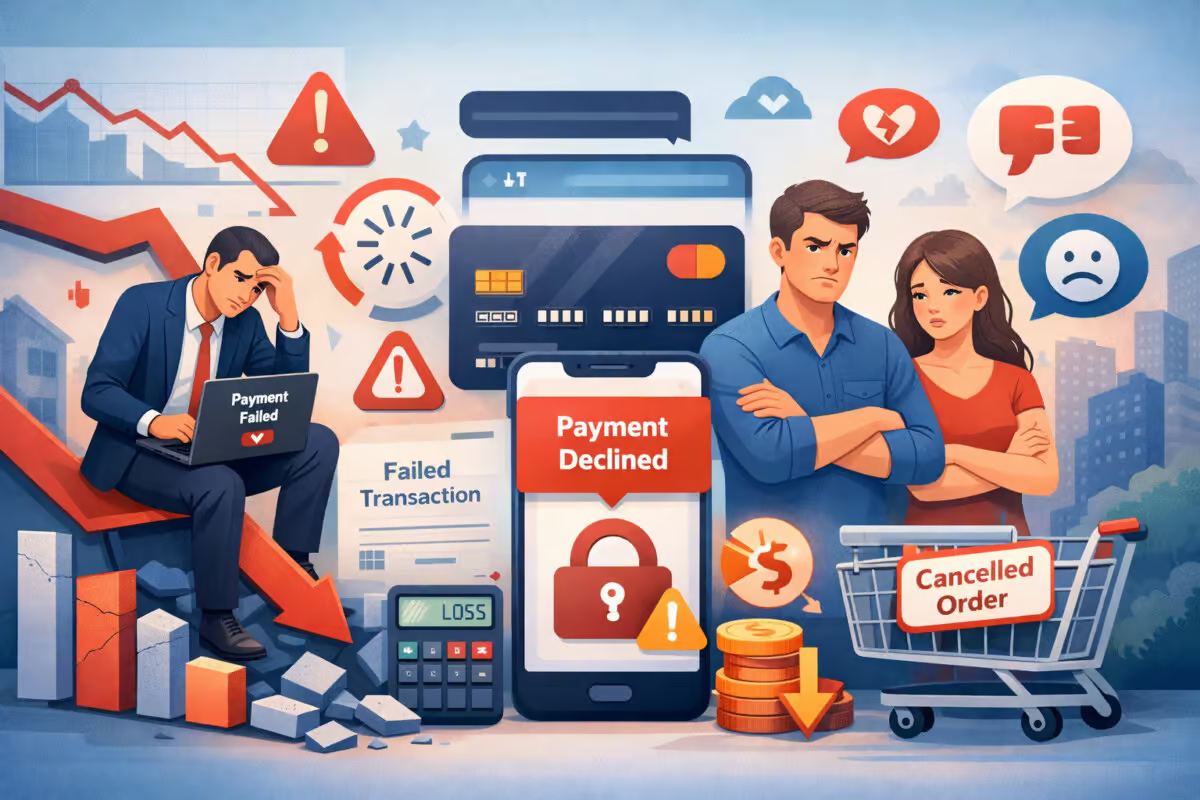
Failed transactions are not always final losses, but they create friction that should not be there.
Imagine a busy service business trying to collect invoices after work is completed. If card links fail, stored payments do not run, or the customer has trouble paying online, collections slow down. The same is true in retail when card readers lag, or in restaurants when terminals disconnect in the middle of service.
An unreliable processor can lead to:
- more abandoned checkouts
- more customer service complaints
- more manual re-entry of payments
- slower collections
- lost repeat business
- greater staff stress and training burden
If your team has workarounds for payment failures, that is useful in the short term, but it also means the system is forcing your people to compensate for weak infrastructure. That is rarely sustainable.
Reliable payments should feel uneventful. If they regularly become a source of friction, your business may have outgrown its current provider.
Sign 1: Funding Is Slow, Unpredictable, or Hard to Track
Getting paid is not the same as having cash available when you need it.
Many businesses discover this the hard way. Sales come through, but deposits arrive later than expected. Funding timelines vary from one day to the next. Reserve holds appear without much warning. Weekend transactions settle differently than weekday ones. Your team ends up guessing when funds will actually hit the account.
Slow or inconsistent funding is one of the most important signs that you may need a better payment processor. It directly affects cash flow, purchasing, payroll planning, and confidence in daily operations. For a growing business, settlement speed is not just a convenience. It is part of working capital management.
Why Settlement Speed Matters to Daily Operations
Cash flow pressure does not always come from low sales.
Sometimes it comes from timing. You may be booking revenue consistently, but if deposits take too long to arrive, the business can still feel tight. This is especially difficult for companies that pay vendors frequently, carry inventory, manage tips, run payroll on fixed dates, or operate with thinner margins.
Slow funding can create problems such as:
- difficulty covering routine operating expenses
- delays in restocking or purchasing materials
- uncertainty around payroll timing
- more reliance on short-term borrowing
- less flexibility during seasonal swings
- extra time spent reconciling expected versus actual deposits
When funding is unpredictable, it also becomes harder to plan. Owners and finance teams need to know when money is expected and what factors can delay it. If settlement rules feel confusing or inconsistent, your processor may not be meeting the needs of the business.
Payment processing for small business operations works best when funding timelines are clear and dependable. Even if next-day funding is not essential for every business, consistency matters.
Warning Signs That Funding Delays Are a Processor Issue
Not every deposit delay means the processor is at fault. Banks, weekends, holidays, card mix, and account risk reviews can all affect timing. But repeated uncertainty is a red flag.
Pay close attention if you notice:
- deposits showing up later than your agreement suggests
- unexplained holds or reserve activity
- frequent discrepancies between batch close and actual funding
- poor visibility into pending settlements
- limited reporting on deposit timing and payout history
- support teams giving vague answers about when funds will arrive
These issues can be even more painful when your business is expanding into new channels like e-commerce, mobile invoicing, or recurring billing. Growth adds complexity, which means your processor needs stronger reporting, better communication, and more dependable settlement practices.
If your provider acts as though funding confusion is normal, it may be time to reevaluate the relationship.
What Better Funding Support Looks Like
A better payment processor should not promise magic, but it should offer clarity.
You should be able to understand:
- when batches close
- how long different payment types typically take to settle
- how weekends and holidays affect timing
- when holds may occur and why
- where to see pending deposits and reconciliation details
- who to contact when something looks wrong
Funding support also becomes more valuable when paired with flexible payment acceptance methods. In some cases, adding or optimizing bank-based payments can improve collections for certain transaction types. For businesses exploring alternatives, this guide to ACH processing benefits and use cases can be helpful.
The real test is simple: does your processor help you predict cash movement with confidence, or does it leave you guessing? If it is the second one, the problem is not just timing. It is an operational risk.
Sign 2: Customer Support Is Weak When You Need Help Most
You do not fully know how good a processor is until something goes wrong.
Support matters when a terminal stops working before a lunch rush, when online checkout errors appear after hours, when a suspicious transaction needs review, or when deposits do not line up with settlement reports. In those moments, generic answers and long wait times are not enough.
If your processor is difficult to reach, slow to respond, or unable to solve problems efficiently, that is a major reason to consider a better payment processor. Good support is not a bonus feature. It is a core part of the service you are paying for.
The Hidden Cost of Poor Support
Weak support creates losses in ways that are easy to underestimate.
When your team cannot get timely help, simple issues turn into long disruptions. Staff members spend time troubleshooting on their own. Managers step away from customers to call help lines. Refunds and chargebacks get delayed. Technical confusion spreads because nobody is sure what the correct process is.
Poor support often leads to:
- longer downtime during payment outages
- more customer frustration at checkout
- unresolved billing or statement questions
- slower dispute handling
- internal confusion about setup, reporting, or compliance
- a growing reluctance to adopt new features
Some businesses stay with a processor because switching feels hard, even though support is already failing them. But a provider that disappears when you need answers is not really supporting the business at all.
This matters even more if your operation is multi-location, processes high monthly volume, or depends on multiple payment channels. Complexity increases the need for responsive service and knowledgeable account management.
Signs You Are Not Getting the Level of Support You Need
Bad support is not always rude or obviously unhelpful. Sometimes it is simply too generic to be useful.
You may need to switch payment processor providers if you regularly encounter:
- long hold times during urgent issues
- support agents who do not understand your setup
- repeated transfers between departments
- ticket responses that do not answer the actual question
- no dedicated contact for account reviews or growth planning
- unclear dispute or chargeback guidance
- poor onboarding and minimal training for staff
Many business owners also discover that their support experience changes after signing up. The sales process feels attentive, but service becomes harder to access once the account is live. That is another reason to ask specific support questions before choosing a new provider.
For businesses dealing with disputes, support quality matters even more. Chargebacks can be expensive, time-consuming, and damaging when handled poorly. If you need a useful refresher on dispute processes and prevention, this guide on how chargebacks work and how to reduce them adds helpful background.
What Strong Payment Support Should Include
A better provider should offer more than a phone number.
Strong support often includes:
- accessible help during the hours your business actually operates
- knowledgeable technical assistance for equipment and integrations
- clear escalation paths for urgent issues
- useful reporting help and statement review support
- guidance during disputes, holds, or risk reviews
- onboarding support for new hardware, software, or staff training
- proactive account reviews as the business grows
The best payment processor for business needs is not necessarily the one with the flashiest interface. Often, it is the one that picks up the phone, understands your setup, and resolves issues without bouncing you around.
Account management also matters when your business is evolving. If you are adding locations, changing POS systems, launching subscriptions, or improving invoicing workflows, your processor should help you think through the payment side of those changes. That is part of supporting growth, not just processing transactions.
Sign 3: Your Processor Has Limited Features, Outdated Technology, or Weak Integrations
A processor can be stable enough to keep taking payments and still hold your business back.
This often happens when the underlying technology no longer fits how the business operates. Maybe the processor works fine for in-person card payments, but struggles with online checkout. Maybe reporting is too basic.
Maybe it does not integrate cleanly with your accounting software, CRM, e-commerce platform, field service software, or POS. Maybe recurring billing exists, but feels clunky and manual.
An outdated payment processor can slow growth even if it rarely causes dramatic outages. The issue is that it forces your business to work around the system instead of letting the system support the business.
How Outdated Payment Technology Creates Operational Drag
Modern businesses often accept payments in more than one way.
You may be taking cards at the counter, sending invoices by email or text, storing cards for repeat customers, offering online checkout, running subscriptions, or using mobile devices in the field. If those channels do not connect well, your team ends up doing extra work that should not be necessary.
Weak technology often leads to:
- duplicate data entry across systems
- manual reconciliation between payment reports and accounting records
- limited visibility into customer payment history
- inconsistent experiences across sales channels
- slower checkout and more staff training time
- difficulty adding new payment methods or sales tools
These are common payment processor problems for businesses that have grown faster than their original systems. What started as a simple setup may now be creating bottlenecks in finance, customer service, and operations.
If you want a better sense of how payment systems connect with customer-facing tools, this overview of choosing the right POS setup is useful for understanding how payments can support daily business workflows beyond the transaction itself.
Features a Growing Business Often Needs
Not every business needs advanced payment features. But many growing businesses need more than basic card acceptance.
Useful capabilities may include:
- strong in-person and online payment support
- mobile payment acceptance for field teams
- digital invoicing and payment links
- recurring billing tools
- tokenized card storage
- real-time or near-real-time reporting
- user permissions and multi-location controls
- clean accounting and software integrations
- customer payment history in one place
- fraud tools and dispute management workflows
Merchant services for growing business operations should support expansion rather than forcing patchwork fixes. If your provider cannot keep up with the way you sell today, it will struggle even more as your business adds complexity tomorrow.
Businesses also benefit from understanding where a gateway fits into the larger payment stack. For a deeper look, this explainer on how payment gateways work can help clarify what may need improvement when online payments feel disconnected or outdated.
When Limited Integrations Become a Growth Problem
Integration issues usually start as annoyances.
A report does not export the way accounting needs. Refund data does not sync correctly. Online orders require separate reconciliation. Staff members have to enter invoice payments manually into the back office. These issues seem manageable until transaction volume grows.
At that point, limited integrations create real business costs:
- more labor spent on back-office cleanup
- more errors in books and reporting
- slower month-end close
- less confidence in payment data
- weaker visibility into customer behavior
- slower adoption of new tools and channels
To improve payment processing system performance, many businesses do not need a complete overhaul of every tool they use. They need a processor that integrates better with the systems already driving the business.
That is often the moment when owners realize they do not just need a new terminal or a lower rate. They need a better payment processor built for where the business is now.
Quick Comparison: Warning Signs, Business Impact, and What to Do Next
| Warning sign | What it can hurt | What to do next |
| High fees and unclear pricing | Profit margins, forecasting, cost control | Review statements, identify all fee categories, compare pricing models |
| Frequent failed payments or outages | Revenue, customer trust, staff productivity | Audit transaction failures, test checkout flows, review approval and reliability patterns |
| Slow or inconsistent funding | Cash flow, payroll planning, vendor payments | Map settlement timing, investigate holds, compare funding options |
| Weak support and poor account help | Downtime, dispute handling, staff stress | Test support responsiveness, ask about escalation paths and onboarding help |
| Limited features or outdated integrations | Growth, reconciliation, multi-channel selling | List must-have tools, review integration gaps, assess future needs before switching |
How to Evaluate Whether It Makes Sense to Switch Payment Processor Providers

Not every frustration means you should immediately leave your current provider.
Sometimes the issue can be fixed with better configuration, staff training, updated hardware, or a pricing review. But if problems are recurring, costly, or tied to the processor’s core limitations, a change may be the smarter move.
Start by looking at the total business impact, not just one symptom. A processor that is slightly expensive but extremely reliable and well supported may still be a good fit. A processor with an attractive headline rate but poor uptime, weak reporting, or slow support may end up costing far more in hidden ways.
Ask practical questions such as:
- Are fees transparent and reasonably predictable?
- Is checkout reliable across all sales channels?
- Are funding timelines consistent enough for your cash flow needs?
- Does support solve issues quickly and accurately?
- Can the system support where the business is headed next?
- Does the processor integrate with your existing tools well enough?
The goal is not to chase novelty. It is to remove friction that is actively hurting business performance.
What to Look for in a Better Provider
If you decide to explore alternatives, define your requirements before comparing offers.
Too many businesses focus on a quoted rate without checking the broader service model. That can lead to another poor fit. The best payment processor for business needs should align with how you sell, how your team works, and what the next stage of growth looks like.
Look for a provider that offers:
- clear, understandable pricing
- dependable transaction performance
- consistent funding and clear settlement visibility
- support that is accessible when your business actually needs it
- tools for in-person, online, mobile, invoice, or recurring payments as needed
- clean integrations with POS, accounting, CRM, or e-commerce systems
- scalable features for future growth
- helpful onboarding and migration support
Also ask how the provider handles holds, disputes, terminal deployment, reporting, and multi-location management. Those details matter once the account is live.
Common Mistakes Businesses Make When Choosing a New Processor
Switching processors can solve real problems, but only if the new choice is made carefully.
A common mistake is focusing only on rates. Cost matters, but pricing alone does not tell you how reliable, scalable, or responsive the provider will be. Another mistake is failing to ask detailed questions about compatibility with your existing systems.
Other common missteps include:
- choosing a provider without reviewing the contract structure
- ignoring support quality during the sales process
- underestimating the importance of reporting and reconciliation
- not confirming integration details in advance
- failing to involve operations, accounting, and front-line staff in the decision
- assuming every processor supports every business model equally well
If your business sells in multiple ways, run real-world scenarios before you commit. Ask how the processor handles partial refunds, recurring billing, invoice payments, offline mode, mobile usage, and role-based permissions. The right answers should be specific, not generic.
How to Improve Payment Processing System Performance Without Disrupting Operations
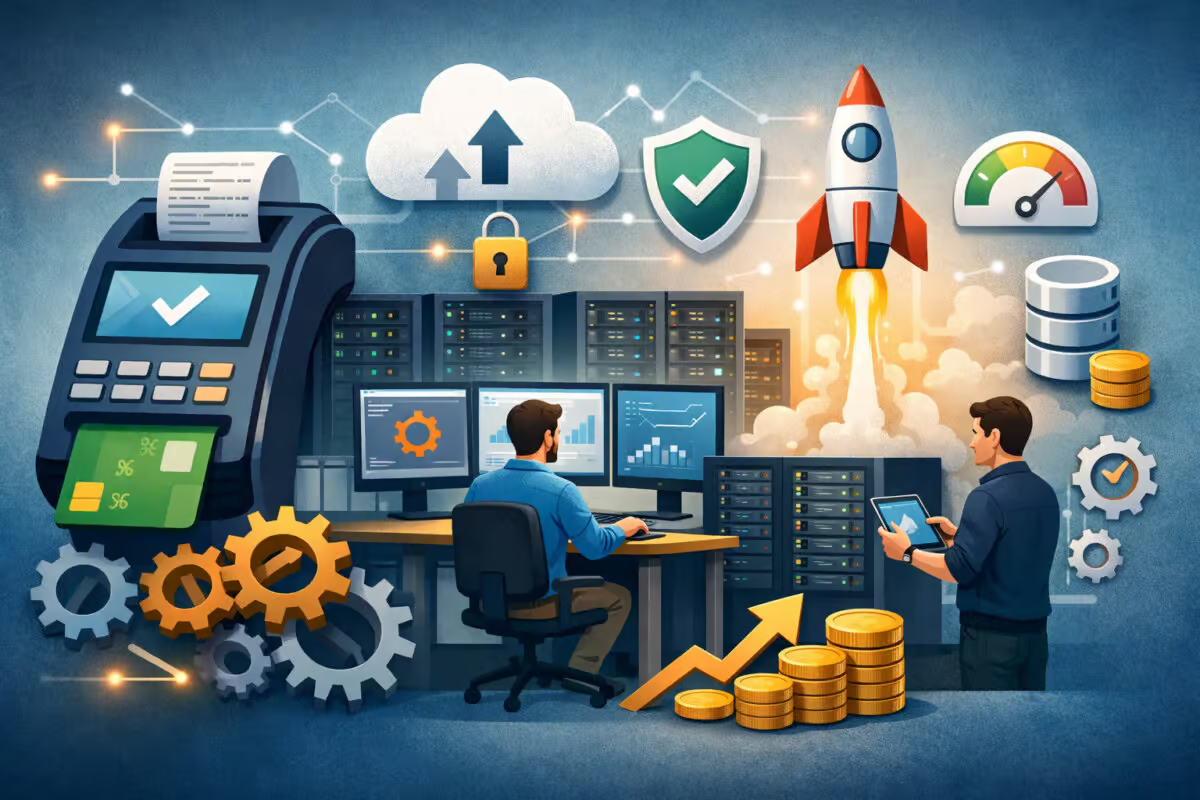
A processor change does not need to create chaos.
In fact, many transitions go more smoothly when the business prepares properly. The key is to treat the change as an operational project, not just a sales decision. That means thinking through workflows, responsibilities, testing, and timing before the switch happens.
To improve payment processing system performance with minimal disruption:
- document your current setup, including hardware, software, gateways, and reporting processes
- identify every payment channel you use today
- make a list of must-have integrations and features
- review your statement history and dispute patterns
- train staff before the switch, not after
- test transactions in every channel before going live
- plan around your busiest selling periods
- confirm how old settlements, refunds, and chargebacks will be handled during the transition
The smoother the preparation, the easier it is to move to a better payment processor without confusing your team or customers.
Steps to Prepare for a Smoother Processor Transition
A well-planned transition reduces risk and helps the new provider succeed from the start.
1. Audit your current payment workflow
Map the full payment journey from checkout to deposit to reconciliation. Include in-person sales, online payments, invoices, recurring billing, refunds, and chargebacks. This makes it easier to spot what the new setup must support.
2. Gather statements and account details
Have several months of statements, fee summaries, settlement reports, and equipment details ready. This helps with pricing comparisons and avoids surprises during setup.
3. Confirm integration requirements early
Do not assume the new provider will work the way you need. Confirm connections with POS systems, shopping carts, accounting software, field tools, gateways, and customer management systems before launch.
4. Create a cutover plan
Choose a realistic go-live window. Avoid your busiest sales periods if possible. Decide who will lead testing, staff training, and day-one troubleshooting.
5. Train for real scenarios
Make sure staff know how to process sales, refunds, voids, tips, invoice payments, and end-of-day closing procedures. Good training reduces stress and helps the business see benefits faster.
Frequently Asked Questions
Here are some common questions business owners ask when deciding whether they need a better payment processor.
How do I know if my payment processor is actually the problem?
Is switching payment processors risky for a small business?
What is the biggest sign that I need a better payment processor?
Can I improve my payment processing system without changing providers?
Should I choose a payment processor based only on lower fees?
What should a growing business look for in merchant services?
How long does it take to see the benefits of a better payment processor?
What questions should I ask before signing with a new payment processor?
Conclusion
Many businesses live with the wrong payment processor longer than they should.
They put up with confusing fees, failed transactions, delayed funding, weak support, and outdated technology because the system still sort of works. But “sort of works” is not a strong standard for something that touches revenue, customer trust, and daily operations.
If your current setup is creating payment processor problems that affect margins, cash flow, customer experience, or back-office efficiency, it is worth taking seriously. The right processor should help the business move faster, collect payments more reliably, understand costs more clearly, and support growth with less friction.
A better payment processor is not just about switching vendors. It is about creating a smoother, more dependable payment experience for your customers and a more manageable operating environment for your team.
If several of the signs in this article sound familiar, now is a good time to review your current setup carefully. The sooner you identify what is holding the business back, the sooner you can build a payment system that supports where you want to go next.