
A registered ISO (Independent Sales Organization) in merchant services is a payments business that is authorized to market, sell, and support merchant processing services under the oversight of a sponsoring acquiring bank and the card networks.
In plain terms: a registered Independent Sales Organization (ISO) helps businesses get set up to accept card payments, but it does so through an acquiring bank (and often through a processor), rather than being the bank itself.
This matters because card payments run on a tightly governed ecosystem. The card networks require many third parties—especially those selling merchant accounts—to be registered and tied to a sponsor that is directly accountable for compliance, underwriting, and risk controls.
That’s why you often see a disclosure in a website footer that says something like: “XYZ is a registered ISO of ABC Bank…”—that line is not decoration; it signals the ISO’s place in the regulated chain of responsibility.
A key clarification: the word ISO in payments can be confused with other “ISO” terms (like the ISO 20022 messaging standard). A registered ISO in merchant services is about sales/servicing authorization and network registration, not a data standard.
In the sections below, you’ll get a current, detailed, easy-to-follow guide to what a registered Independent Sales Organization (ISO) is, how registration works, what responsibilities come with it, how merchants can evaluate one, and where the model is headed next.
Registered ISO meaning: the simplest definition (and what “registered” adds)

A registered ISO is an Independent Sales Organization that has been formally registered under card-network programs via an acquiring bank sponsor.
Practically, that ISO is allowed to solicit merchant accounts, provide merchant onboarding assistance, sell or deploy payment hardware/software, and deliver customer support, while operating within a sponsor-controlled compliance and risk framework.
An ISO by itself is not a bank and does not “create” card acceptance. Instead, it acts as a go-to-market and service layer between merchants and the acquiring/processing infrastructure.
Many ISOs provide hands-on support that a bank or large processor might not deliver at the local or vertical level—like on-site setup, training, POS configuration, chargeback support, and ongoing optimization.
What does “registered” add? Registration generally means:
- The ISO is known to the card networks under a sponsor’s umbrella.
- The ISO has been vetted to a level appropriate for its role (sales, support, sometimes more).
- The ISO’s activities are subject to rules, monitoring, and accountability routed through the sponsor.
For example, Visa describes Independent Sales Organizations as third-party agents that may conduct merchant solicitation/sales and related support functions (in Visa’s Third Party Agent registration framework).
And industry guidance commonly emphasizes that an ISO/MSP must be sponsored by a member bank and that sponsor disclosure is typically shown in marketing materials.
Because this is a registered ISO article, keep this keyword in mind: registered ISO is not just a label—it’s the visible signal that the company operates inside a sponsor-governed payments chain rather than operating informally.
Where a registered ISO sits in the payments stack (who does what)
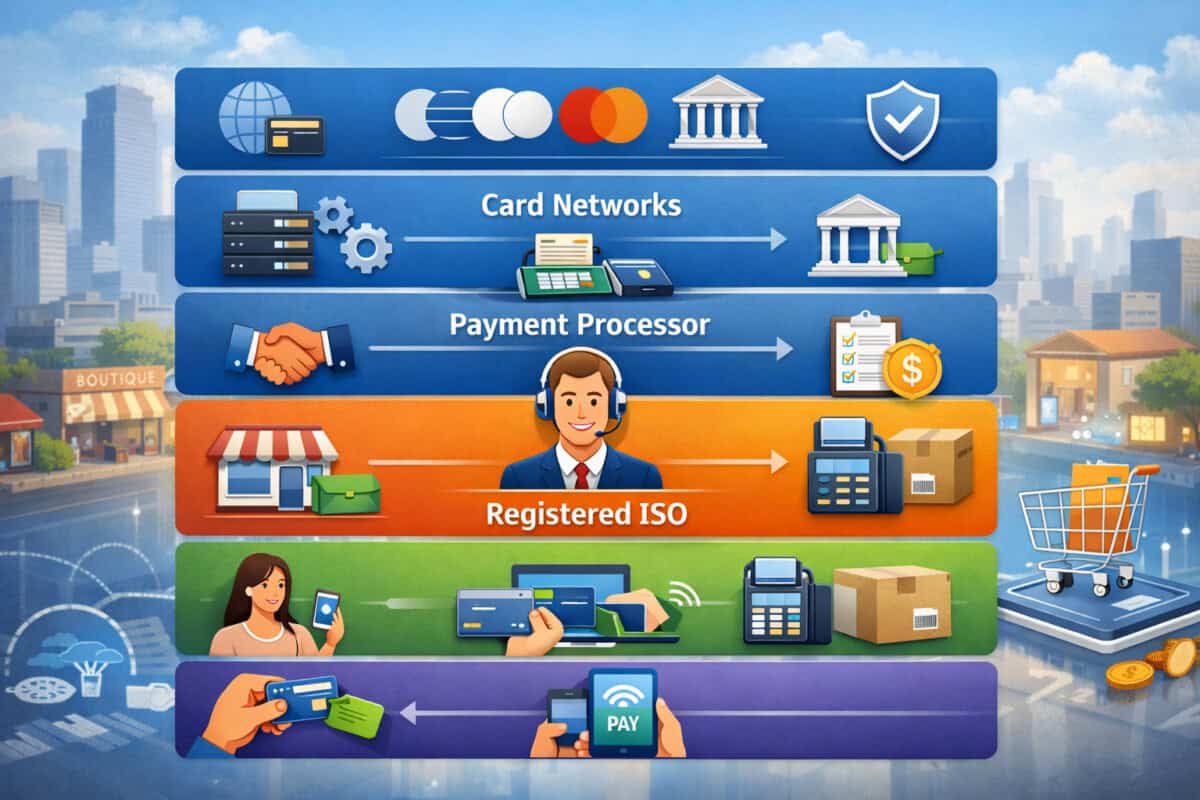
To understand a registered ISO, it helps to see the players around it. Merchant services can feel like one product, but it’s really a chain:
The merchant (your business)
You sell goods or services and want to accept card payments in-store, online, mobile, or recurring. You care about approval speed, pricing, reliability, dispute support, and deposit timing.
The registered ISO (the distribution and service layer)
A registered ISO typically handles sales, solution design, onboarding guidance, and support. Many build specialized bundles for certain industries: retail POS, field services, professional billing, subscription tools, or integration for software platforms.
A registered ISO often also manages the relationship—meaning you call them first when you need help, even if the acquiring bank and processor are behind the scenes.
The processor (the transaction engine)
Processors provide the technology that routes transactions, formats messages, manages authorization/capture, and supports settlement reporting. Some ISOs are closely aligned with a processor; others are multi-processor.
The acquiring bank (the sponsor and bank-of-record)
The acquirer is the financial institution that connects merchants into card networks for acceptance and settlement. This bank is typically the entity that sponsors the registered ISO, and it is the party the networks hold responsible at the highest level for merchant acceptance programs.
The card networks
They publish operating rules and registration frameworks and enforce compliance for entities connected to their rails. Your card acceptance must align with network rules, data security expectations, and risk programs.
This division of labor explains why a registered ISO can be very “front and center” in your experience while still not being the bank. It’s also why sponsor disclosure exists: the sponsor bank is part of the accountability structure behind the registered ISO relationship.
Registered ISO vs payment processor vs payment facilitator vs aggregator

Merchants often hear several terms—sometimes used loosely. But the differences matter.
Registered ISO vs payment processor
A processor runs the transaction infrastructure and back-office systems. A registered ISO sells and supports merchant solutions that use that infrastructure. Some companies are both (or own both), but many are not.
A useful way to think about it: the processor is the engine, the acquiring bank is the licensed connector, and the registered ISO is often the performance shop that configures the engine for your business and keeps it running smoothly.
Registered ISO vs payment facilitator (PayFac)
A PayFac (payment facilitator) typically onboards sub-merchants under its own master arrangement. This can offer faster onboarding and a simplified merchant experience, but it also centralizes compliance and risk in the PayFac program.
A registered ISO more commonly supports traditional merchant accounts (or a hybrid approach), where underwriting and risk are structured around the sponsor bank’s merchant acquiring program.
Registered ISO vs aggregator
An aggregator groups many merchants under a shared structure (often aligned with PayFac-style models). Aggregators can be excellent for very small or low-risk merchants who want speed and minimal setup. But they can also involve more standardized controls and sometimes less flexibility for complex businesses.
Why this distinction matters to merchants
The registered ISO model often shines when you need:
- More tailored underwriting for your business model
- More specialized hardware/software workflows
- Deeper support, training, and relationship management
- Multiple processing options or custom routing
At the same time, the best providers in any model can be strong. The winning move is to understand which structure fits your operational complexity and risk profile—and to confirm that the company presenting itself as a registered ISO actually has sponsor relationships and clear disclosures.
What registered ISO registration typically involves (sponsorship, vetting, and disclosure)

Registration is not just paperwork; it’s the start of a compliance relationship.
Sponsorship is the anchor
A registered ISO is typically sponsored by an acquiring bank (or a sponsor structure that routes back to an acquirer). That sponsor is the party that can connect merchants to the networks and is accountable for the third party’s conduct.
Industry guidance commonly notes that ISO/MSP registration is tied to sponsorship by a bank that is a member of the card networks, and that sponsor disclosure is part of how the market verifies registration status.
Due diligence and business review
While exact requirements vary by sponsor and program type, registration commonly involves:
- Company formation documents and ownership details
- Background checks on principals
- Financial review and operational capability checks
- Policies for onboarding, customer support, dispute handling
- Security and data-handling expectations
These steps exist because a registered ISO can influence merchant onboarding, pricing promises, equipment deployment, and support practices—all of which affect merchant outcomes and network risk.
Functional scope: what the ISO is allowed to do
Card network frameworks often define third-party agent categories and functional descriptions (for example, merchant solicitation/sales and merchant support activities). Visa’s functional descriptions include an ISO category tied to merchant solicitation and related activities.
Ongoing disclosure expectations
If you’ve seen footer text naming a sponsor bank, that’s commonly used as a public signal that the registered ISO is operating through a sponsor relationship. The idea is simple: merchants should be able to identify the accountable bank in the chain.
For merchants, this is practical: if a provider claims to be a registered ISO but has no sponsor disclosure, no clear legal entity information, and no contract clarity, you should slow down and verify.
What a registered ISO actually does for merchants (services, value, and day-to-day support)
A registered ISO can be “just sales,” but the best registered ISO organizations operate more like a merchant success partner. Here’s what that can look like in real life.
Merchant onboarding and solution design
A registered ISO helps match your business to a setup that fits your workflow:
- In-store POS vs terminal vs mobile
- Ecommerce gateway + fraud tooling
- Recurring billing and invoicing
- Multi-location reporting
- Tips, surcharging (where permitted), cash discount programs
- Industry-specific checkout flows
This solution design matters because merchants don’t fail at payments due to one big mistake; they fail because of dozens of small mismatches—hardware that doesn’t fit, reporting that’s confusing, chargebacks that aren’t managed, or pricing structures that don’t align with ticket size.
Ongoing support
Support is a major reason merchants choose a registered ISO. Common support needs include:
- Funding and deposit troubleshooting
- Dispute/chargeback triage and representment guidance
- PCI and security guidance
- Terminal/POS replacement logistics
- Staff training refreshers
- New location rollouts
Risk navigation and account stability
A strong registered ISO helps you operate in ways that reduce holds, reduce chargebacks, and improve account longevity. That means coaching on:
- Clear refund policies
- Order fulfillment evidence
- Customer communication logs
- Fraud prevention configuration
ISOs are often closer to merchants than banks are, so they can translate risk rules into operational habits that keep your account stable.
Compliance responsibilities of a registered ISO (what merchants should know)
A registered ISO touches sensitive areas: pricing promises, onboarding expectations, marketing disclosures, and sometimes guidance around security. Even when the sponsor and processor carry major obligations, the registered ISO still has real responsibilities.
Marketing and sales practices
A registered ISO should be disciplined about:
- Transparent pricing explanations (interchange, assessments, markup, fees)
- Honest equipment terms (purchase vs lease, support costs)
- Clear contract length and renewal language
- Accurate claims about approval timeframes and funding
Merchants should treat vague promises as a risk signal. If the registered ISO can’t explain rates in plain language, that’s a preview of future support quality.
Data security and PCI awareness
Many ISOs do not directly store card data, but they often guide merchants through environments that do. Visa’s third-party agent descriptions distinguish roles that do not have access to cardholder data environments in certain categories, reinforcing that functions and access levels matter.
A responsible registered ISO will:
- Encourage PCI-compliant devices and validated solutions
- Explain tokenization and point-to-point encryption in practical terms
- Provide secure onboarding practices (no emailing full card data, etc.)
Risk controls and prohibited activity
Merchants should also know that certain business models require deeper underwriting and monitoring. A registered ISO should help merchants understand:
- What documentation is needed (fulfillment proof, supplier invoices, licensing where applicable)
- Why sudden volume spikes can trigger risk reviews
- How chargeback ratios and refund behaviors affect account stability
Regulatory awareness (federal and state)
In the United States, money movement, identity verification, and risk monitoring can intersect with federal and state expectations depending on the exact services offered (especially if the company moves beyond card acceptance into broader funds flow).
A good registered ISO won’t give legal advice, but it will operate with clear compliance boundaries and partner with reputable sponsor institutions.
For merchants, the takeaway is simple: a registered ISO should make compliance easier to follow, not harder to understand.
How merchants can verify a registered ISO and avoid look-alikes
Because “ISO” sounds official, some companies use the term casually. Merchants should verify signals that indicate a legitimate registered ISO relationship.
Look for sponsor disclosures and legal clarity
A common verification method is sponsor disclosure (often in the footer) naming the sponsor bank and location, which is widely described as a standard industry practice for registered ISO/MSP identification.
Also check for:
- A clear legal company name (not just a brand)
- A physical business address
- Transparent support contact routes
- Clear contract ownership (who your agreement is with)
Ask “who is the acquirer and who is the processor?”
A legitimate registered ISO should answer directly:
- Which acquiring bank sponsors the program
- Which processor(s) power the platform
- Whether you are getting a traditional merchant account, PayFac-style sub-merchant account, or a hybrid
If the salesperson avoids these questions, treat that as a risk indicator.
Evaluate pricing explanations, not just pricing numbers
Two providers can quote the same “rate” and still be wildly different in cost. A strong registered ISO will break down:
- The underlying pass-through costs (where applicable)
- The markup model
- Monthly fees and minimums
- Gateway, batch, PCI program, and support costs
- Non-qualified/qualified structures (and why many merchants avoid them)
Confirm support quality before you need it
Call support before signing. Ask:
- “How do chargebacks get handled?”
- “What’s your average response time?”
- “Do you provide onboarding and staff training?”
A registered ISO that invests in support will have clear answers and documented processes.
Registered ISO business model: how they make money (and how merchants can judge fairness)
A registered ISO is a business. Understanding how it earns revenue helps you evaluate whether your deal is likely to stay healthy long term.
Common revenue streams
Registered ISO revenue often includes:
- Processing margin (markup over pass-through costs or bundled pricing margin)
- Monthly account fees or platform fees
- Hardware margin (terminals, POS bundles, peripherals)
- Gateway and value-added services (fraud tools, reporting, loyalty, invoicing)
- Implementation fees for complex setups or integrations
None of these are inherently bad. The question is whether the registered ISO is transparent and whether the pricing aligns with the value provided.
“Good” margin vs “bad” margin
Good margin looks like:
- Clear pricing logic
- Support that actually solves problems
- Tools that reduce disputes and downtime
- Proactive optimization and account reviews
Bad margin looks like:
- Confusing rate tiers that increase costs unpredictably
- Hidden or duplicative monthly fees
- Equipment leases that outlive the hardware’s useful life
- Lock-in penalties that keep you stuck with poor service
The merchant’s fairness checklist
If you want a fair registered ISO relationship, insist on:
- A plain-language explanation of all recurring fees
- A clear cancellation process
- Written clarification of equipment ownership and warranty
- A support SLA expectation (even informal)
- A dispute-support workflow outline
The best registered ISO providers prefer educated merchants because clear expectations reduce churn and support friction.
When a registered ISO is the best choice (and when it’s not)
A registered ISO can be ideal—but it’s not always the best fit.
Best-fit scenarios for a registered ISO
Choose a registered ISO when:
- You need customized onboarding or a specialized vertical solution
- You have multi-location complexity or multiple sales channels
- You want a relationship-based support model
- You expect growth and want pricing that can evolve with volume
- You need integration help with software, POS, or operational tooling
ISOs can add huge value when your business is more than “swipe a card and go.”
When another model may be better
A different approach may be better when:
- You are very small and want ultra-fast signup with minimal setup
- You have extremely simple needs and don’t want ongoing support touchpoints
- Your business has low transaction volume and your main goal is “set it and forget it”
In those cases, a simplified onboarding model can feel easier.
The practical way to decide
Don’t choose based on labels alone. Choose based on:
- Account stability history (holds, closures, disputes)
- Support quality and response time
- Tooling fit (POS, online checkout, invoices, recurring)
- Pricing transparency and contract clarity
- Willingness to help you reduce risk, not just process payments
A registered ISO relationship should feel like a partnership. If it feels like a one-time sale, keep shopping.
Future of the registered ISO model (what’s changing and what to expect next)
The registered ISO model is evolving fast because payments are becoming more software-driven and risk-managed in real time.
Trend 1: ISOs become “payments + software” providers
More registered ISO businesses are bundling:
- Vertical POS software
- Industry-specific checkout flows
- Embedded reporting and analytics
- Integrated invoicing and recurring billing
- Customer engagement tools (loyalty, SMS, memberships)
This shift turns the registered ISO from a reseller into a platform partner. Merchants increasingly prefer one integrated stack over a patchwork of tools.
Trend 2: Tighter oversight, clearer third-party governance
Card networks and sponsors continue to emphasize third-party registration and defined functional roles. Program frameworks like Visa’s Third Party Agent registration descriptions highlight the importance of categorizing what third parties do and how they interact with merchants and data environments.
Prediction: expect more consistent enforcement around:
- Marketing disclosures
- Onboarding quality and underwriting alignment
- Chargeback monitoring and merchant performance programs
- Data security expectations across devices and integrations
Trend 3: AI-driven risk and smarter dispute operations
Risk is moving from periodic review to continuous monitoring. Registered ISO providers that survive and grow will likely invest in:
- AI-assisted fraud detection and anomaly alerts
- Automated evidence collection for disputes
- Smarter refund workflows and customer communication templates
- Real-time merchant health dashboards
Trend 4: More specialization, fewer generalists
As competition increases, many registered ISO companies will specialize in industries where they can deliver differentiated value—because generic processing is increasingly commoditized.
The future registered ISO winner will be the one that reduces friction, reduces disputes, and increases conversion—while staying aligned with sponsor expectations.
FAQs
Q1) What does “registered ISO” mean on a website footer?
Answer: It usually indicates the company is a registered ISO operating under a sponsor bank relationship, and the disclosure names that sponsor. This is widely described as a common way to identify registered ISO/MSP status in the market.
For merchants, it’s a starting point for verification: you can ask who the acquirer and processor are and confirm what kind of account structure you’re being offered.
Q2) Is a registered ISO the same as a merchant services provider (MSP)?
Answer: In everyday conversation, people often use them interchangeably. Some frameworks and explanations note that “ISO” is commonly used in one network’s nomenclature while “MSP” appears in another context.
In practice, what matters more than the label is what the provider does: sales, onboarding, support, and how it is sponsored and governed.
Q3) Does a registered ISO set my rates?
Answer: A registered ISO may propose pricing, but pricing is typically shaped by a combination of pass-through network costs, the program structure, and the ISO’s margin. The right question is not “who sets the rate,” but “can you explain the full cost model clearly?” A strong registered ISO will break down fees and the pricing method without evasiveness.
Q4) Can a registered ISO approve or deny my merchant account?
Answer: A registered ISO may collect information and guide the application, but underwriting authority is generally connected to the acquiring/sponsor side and the processing program’s risk controls. Practically, your approval depends on the sponsor/processor underwriting requirements and your business risk profile.
Q5) Is working with a registered ISO safer than working with a random provider?
Answer: Often, yes—because a registered ISO should be operating inside a sponsor-governed framework with clearer accountability. But “registered ISO” is not a magic shield. You still need to evaluate transparency, support, contract terms, and reputation.
Q6) What should I ask a registered ISO before signing?
Answer: Ask these and judge how clearly they answer:
- Who is the sponsor/acquiring bank?
- Who is the processor?
- What is the exact pricing model and every recurring fee?
- What is the cancellation process and any early termination costs?
- How do you handle chargebacks and fraud support?
- What equipment is included, and do I own it?
A high-quality registered ISO will answer in plain language and put it in writing.
Conclusion
A registered ISO is a critical part of modern merchant services because it bridges the gap between complex payment infrastructure and the real-world needs of businesses. The “registered” part matters because it signals the ISO is operating under a sponsor structure with defined responsibilities and oversight—rather than operating informally.
For merchants, the best outcome is not simply “getting approved.” The best outcome is stable payment acceptance with predictable deposits, lower disputes, strong support, and a solution that fits how you actually do business. A strong registered ISO can deliver that by combining industry expertise, hands-on onboarding, and ongoing operational guidance.
Looking ahead, the registered ISO model is likely to become more specialized, more software-driven, and more tightly governed. Merchants who choose wisely—verifying sponsor clarity, demanding transparent pricing, and prioritizing support—will be positioned to benefit from those improvements rather than being surprised by them.